Local SEO in 2026 is no longer about ranking for a city-wide keyword and calling it a day. The landscape has fundamentally shifted. AI Overviews are reshaping search results, paid ads are eating into organic visibility, and consumers expect hyper-relevant, neighborhood-level results before they walk through your door.
The businesses winning right now aren’t the ones with the biggest budgets. They’re the ones treating every neighborhood, every zip code, and every micro-market as its own SEO battlefield.
In this guide, I’m breaking down exactly what’s changed, what the data says, and how you can build a local SEO strategy for 2026 that turns search visibility into real foot traffic and revenue. Every recommendation here is backed by real statistics from BrightLocal, Google, Birdeye, SOCi, and other industry-leading sources.
If you’re looking for a professional who can implement these strategies for your business, I’ve been deep in the trenches of local search for years, and I’m sharing what actually works.
The State of Local Search: 2026 by the Numbers
Before diving into strategy, let’s establish why local SEO in 2026 deserves your full attention. The data paints a clear picture: local search isn’t slowing down. It’s accelerating.
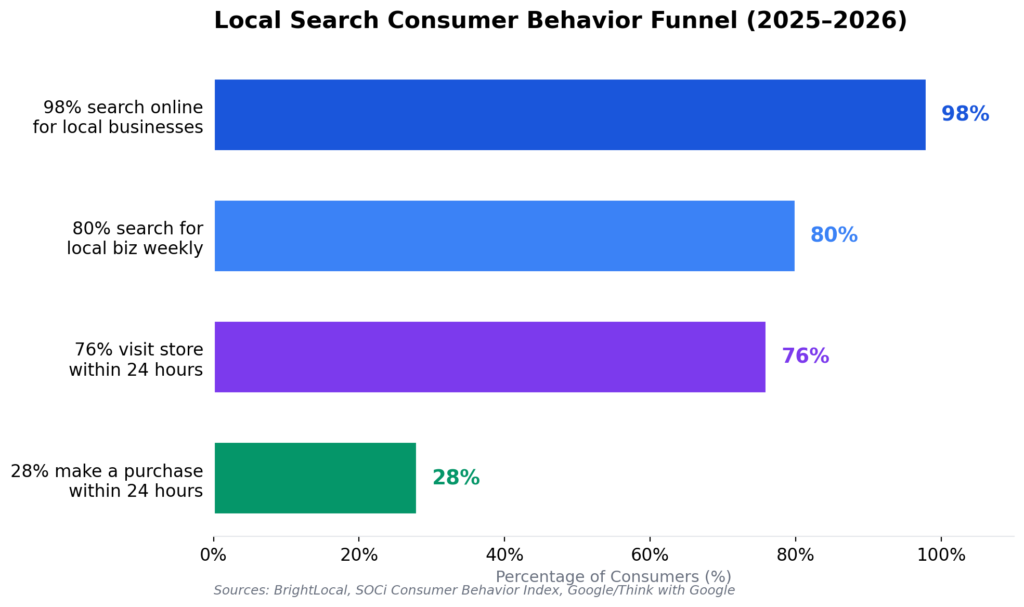
Here’s what the latest research tells us:
| Statistic | Data Point | Source |
|---|---|---|
| Consumers who search online for local businesses | 98% (up from 90% in 2019) | BrightLocal 2025 |
| U.S. consumers who search for local businesses weekly | 80% | SOCi Consumer Behavior Index 2024 |
| Google searches with local intent | 46% | |
| “Near me” mobile searches leading to store visit within 24h | 76% | Google / Think with Google |
| Local mobile searches resulting in a purchase within 24h | 28% | |
| Mobile users who contact a business directly from search | 60% | BrightLocal 2025 |
| Consumers who use Google Maps to find local businesses | 88% | BrightLocal 2025 |
| Google searches happening on smartphones | 58% | SEO.com 2026 |
These aren’t vanity metrics. When 76% of people who search “near me” visit a physical location within 24 hours, and 28% of those searches end in a purchase, we’re talking about the highest-intent traffic channel in digital marketing.
With Google processing an estimated 16 billion searches daily, that 46% local intent figure translates to over 7 billion local searches every single day. If your business isn’t optimized for local search, you’re invisible to a massive audience that’s ready to buy.
Google Business Profile: Your Most Valuable Digital Asset
Your Google Business Profile (GBP) is the single most important piece of your local SEO strategy in 2026. It’s not just a listing. It’s your local homepage within Google’s ecosystem, and it’s often the first (and sometimes only) touchpoint consumers have with your business.
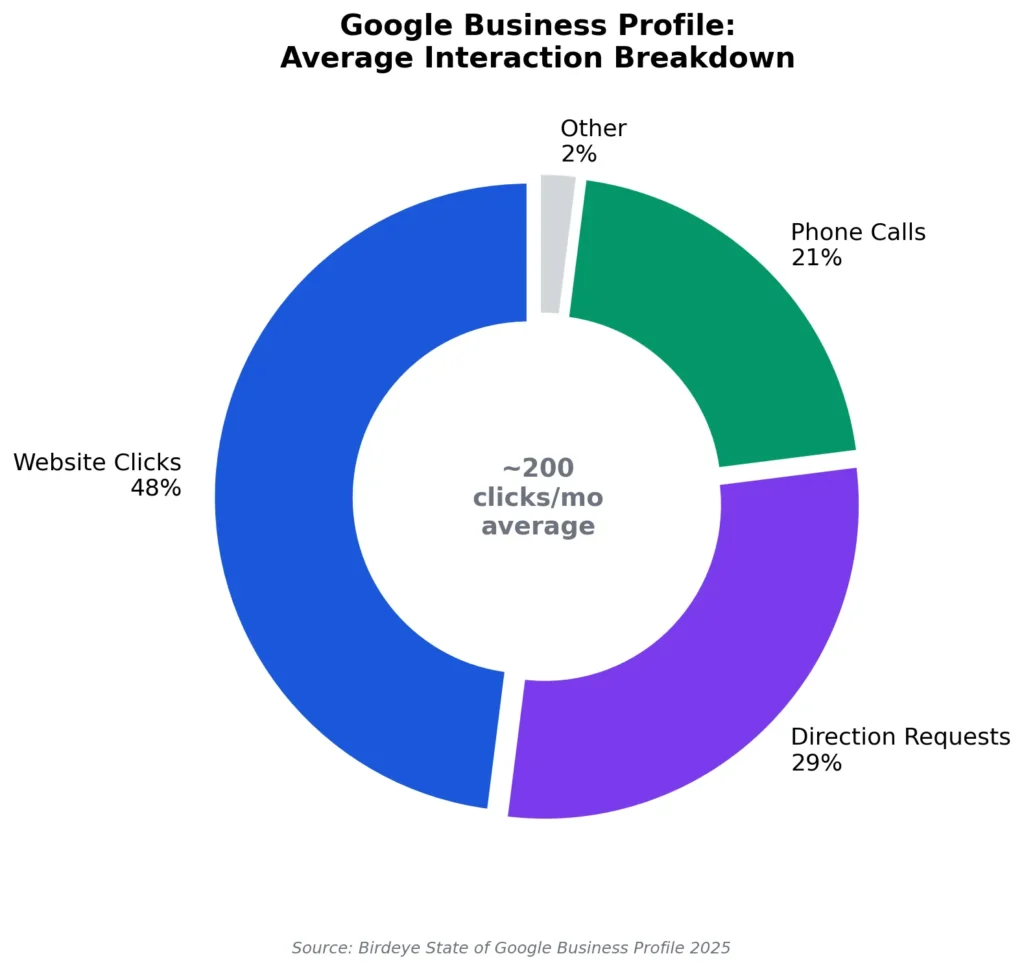
The data on GBP performance is compelling:
| GBP Metric | Data Point | Source |
|---|---|---|
| Average monthly clicks per GBP listing | ~200 | Birdeye 2025 |
| Average monthly views per listing | 1,260 | SQ Magazine 2025 |
| Views from discovery searches | 84-86% | Birdeye 2025 |
| Trust boost from complete profile | 2.7x more likely to be trusted | SeoProfy / Google |
| Click boost from complete information | 7x more clicks | SeoProfy 2026 |
| GBP contribution to local ranking factors | 19%+ | SQ Magazine 2025 |
| GBP interactions from mobile devices | 71% | SQ Magazine 2025 |
| Map Pack traffic boost vs. positions 4-10 | 126% more traffic, 93% more actions | SeoProfy 2026 |
Here’s what stands out: 86% of GBP views come from category-based discovery searches, not branded searches. That means people aren’t finding you by searching your business name. They’re searching for what you do (“dentist open now,” “best plumber near me”) and your GBP listing is what shows up.
The businesses ranking in Google’s top 3 local positions (the “Map Pack”) receive 126% more traffic and 93% more actions like calls and website clicks compared to those ranked 4th through 10th. Getting into that Map Pack isn’t optional. It’s the difference between thriving and being invisible.
How to Optimize Your Google Business Profile in 2026
Based on the data, here’s what moves the needle:
1. Complete every single field. Profiles with complete information get 7x more clicks. That includes business description, services, products, attributes, and FAQs. Don’t leave anything blank.
2. Upload high-quality photos consistently. Verified profiles with 15+ photos see significantly stronger engagement. Businesses with over 100 photos report 520% more calls and 2,700% more direction requests. Add exterior shots, interior views, team photos, and images of your work.
3. Post weekly updates. Businesses that post weekly updates to their GBP (specials, events, announcements) see a 30% increase in customer interactions. Listings with recent posts receive 21% more interactions than inactive ones.
4. Enable every relevant feature. Listings with CTA buttons show a 42% higher engagement rate. Profiles with FAQ sections see a 13% boost in engagement. Don’t leave features unused.
5. Track your performance. Use GBP Insights (now called Performance) and add UTM parameters to your profile links so you can track exactly how much traffic and revenue your listing generates.
For a deeper look at how I approach these optimizations for my clients, check out my portfolio of past work.
AI Overviews: The Biggest Disruptor in Local Search
If there’s one trend that should have every local business owner paying attention in 2026, it’s the explosive growth of AI Overviews (AIOs) in local search results.
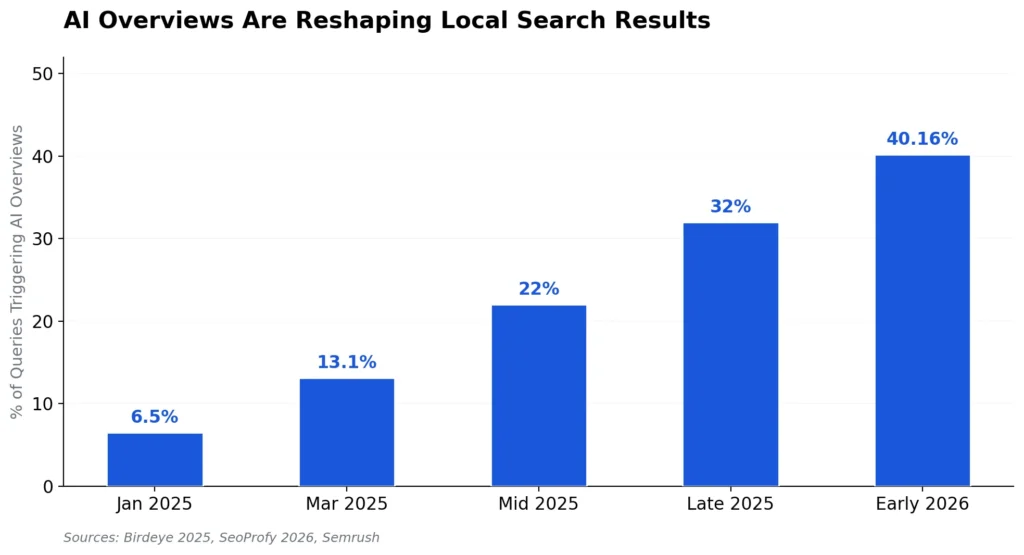
The numbers tell a dramatic story. AI Overviews in Google search grew from appearing in just 6.5% of queries in January 2025 to 13.1% by March 2025, which is a 102% increase in just two months, according to Birdeye. By early 2026, more than 40% of local business queries now trigger Google’s AI Overviews, according to SeoProfy’s analysis.
This matters because AI Overviews fundamentally change how consumers interact with local search results. Instead of scrolling through the traditional Map Pack and organic listings, users now see AI-generated summaries that pull information from multiple sources, including your GBP listing, website, and third-party review platforms.
For local businesses, this creates both a threat and an opportunity:
The threat: AI Overviews can satisfy user intent without anyone clicking through to your website or listing. This contributes to the zero-click search phenomenon, where over 60% of searches now end without a click to any external website.
The opportunity: If your business is the one being cited and recommended within AI-generated answers, you gain an implicit endorsement that no organic listing can match. AI systems are pulling from review sentiment, business attributes, and structured data to decide who gets recommended.
How to Optimize for AI Overviews in Local Search
Structure your content for AI extraction. Use clear, concise answer blocks on your website. If someone searches “best Italian restaurant in [your neighborhood],” your website should have content that directly and specifically answers that question.
Build review depth, not just volume. AI-driven local results now interpret the themes within reviews (speed, quality, friendliness, pricing) not just star ratings. Encourage customers to leave detailed reviews that describe their experience with specific aspects of your service.
Implement schema markup. LocalBusiness schema, FAQ schema, and Review schema help AI systems understand exactly what your business offers and where. This structured data is the language AI speaks when deciding who to recommend.
Maintain NAP consistency everywhere. AI assistants cross-check information from directories like Yelp, BBB, and Yellow Pages to confirm legitimacy. Any inconsistency in your name, address, or phone number across platforms undermines your credibility with both Google and AI systems.
The Rise of Paid Ads in Local Results
One of the most dramatic shifts in local SEO during 2025 and into 2026 has been the explosive growth of paid advertising in local search results.
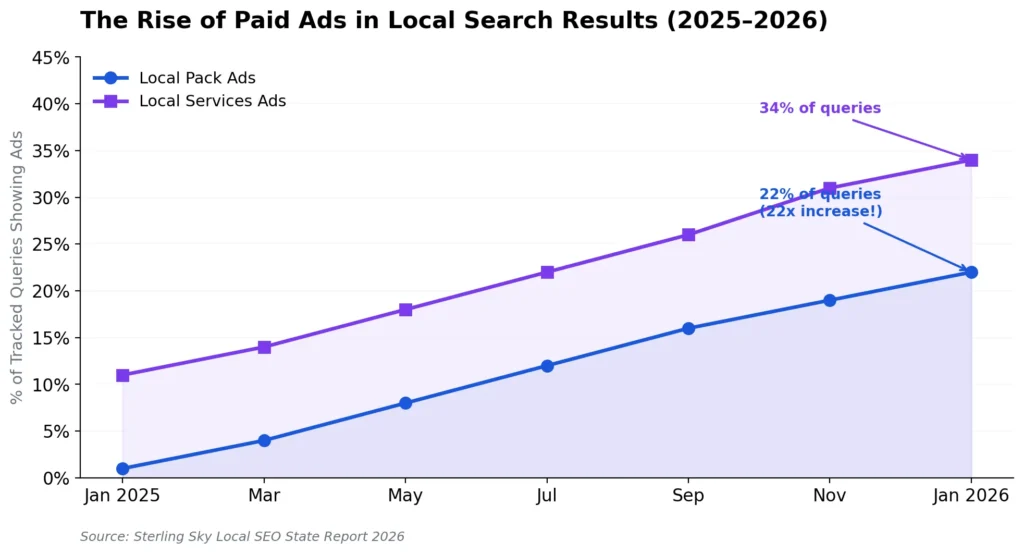
According to Sterling Sky’s 2026 State of Local SEO report, Local Pack ads went from appearing in just 1% of mobile queries in early 2025 to nearly 22% by January 2026, a staggering 22x increase. Local Services Ads (LSAs) grew from 11% to over 31% during the same period.
What does this mean for your organic local SEO strategy? It means organic visibility alone is becoming harder to maintain. The search results page is getting more crowded with paid placements, AI Overviews, and enhanced SERP features. Businesses need a hybrid approach that combines strong organic local SEO with strategic paid local campaigns.
Sterling Sky also found that even businesses with well-ranking Google Business Profiles are seeing declining click-to-call rates from organic listings. Their analysis of 179 profiles across 34 law firms showed a consistent downward trend in organic GBP clicks over two years, even when rankings remained stable.
The takeaway: diversify your local visibility. Don’t put all your eggs in the organic basket. Consider Local Services Ads, Google Ads with location extensions, and ensure your presence across social platforms like YouTube, Reddit, and TikTok where local discovery is also happening.
The Review Economy: Your Reputation Is Your Ranking
Reviews have always mattered for local SEO. In 2026, they’re more critical than ever. Not just for rankings, but for AI visibility and consumer trust.
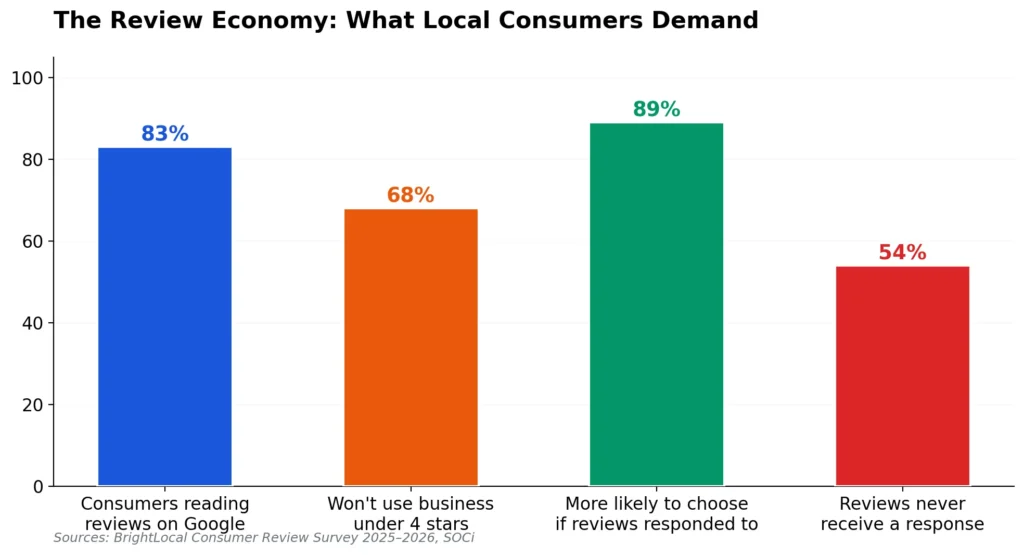
| Review Metric | Data Point | Source |
|---|---|---|
| Consumers who read reviews on Google | 83% | BrightLocal 2025 |
| Won’t use a business under 4 stars | 68% | BrightLocal 2026 |
| More likely to choose business that responds to all reviews | 89% | BrightLocal 2025 |
| Google reviews that never receive a response | 54% | SOCi Local Visibility Index |
| Avg. review count for top 3 local positions | 240+ reviews | Localo 2025 |
| Additional website visits per new review | 80 visits | Birdeye 2025 |
| Conversion increase per 10 new reviews | +2.8% | SOCi 2025 |
| Conversion increase from responding to 25% of reviews | +4.1% | SOCi 2025 |
| Consumers using Instagram for local business reviews | 37% | BrightLocal 2026 |
| Consumers using TikTok for local business reviews | 29% | BrightLocal 2026 |
The numbers tell a clear story. Each additional review results in an estimated 80 additional website visits, and every 10 new reviews increases conversion rates by 2.8%. Yet 54% of Google reviews never receive a response from the business. That’s a massive missed opportunity.
Here’s the emerging trend in 2026: review platforms are diversifying. BrightLocal’s 2026 Consumer Review Survey found that 37% of U.S. consumers now use Instagram to find local business reviews, and 29% use TikTok. Meanwhile, 74% of consumers use at least two review platforms during their research. Your review strategy can’t be Google-only anymore.
And here’s the AI angle: AI search systems now analyze review sentiment at a granular level. They don’t just count stars. They extract themes around service speed, staff friendliness, pricing fairness, and product quality. Rich, detailed reviews give AI systems more signals to work with when deciding whether to recommend your business.
Micro-Market Domination: The 2026 Local SEO Playbook
Here’s where everything comes together. The concept of micro-market domination is about winning your specific neighborhood, district, or service area rather than trying to rank for an entire city.
Why does this work? Because of how AI and modern search treat local queries. There’s only a 23% overlap between the top-ranking websites for the same query in different cities, according to industry research. Local search has become hyper-personalized, meaning your optimization needs to be hyper-localized too.
Step-by-Step Micro-Market Strategy
1. Map your micro-markets. Identify every distinct neighborhood, suburb, or service area where your customers live. Don’t think “citywide.” Think “neighborhood by neighborhood.” Each one represents a separate optimization target.
2. Create location-specific landing pages. Build dedicated pages for each micro-market with unique content. Include local landmarks, neighborhood-specific information, and localized testimonials. Don’t just swap city names. Create genuinely relevant content for each area.
3. Optimize for conversational, long-tail local queries. People aren’t just searching “plumber near me” anymore. They’re asking AI assistants: “What plumber in [neighborhood] is open right now and has good reviews for emergency pipe repairs?” Your content needs to answer these compound, specific queries directly.
4. Build local backlinks neighborhood by neighborhood. Sponsor local events, partner with neighborhood associations, get featured in local news. A link from your local chamber of commerce carries more local SEO weight than a link from a generic national directory.
5. Leverage multiple GBP locations. If your business serves multiple areas, consider whether additional verified locations make sense. Sterling Sky’s 2026 analysis suggests that businesses with multiple GBP listings are better positioned to offset the declining organic visibility from a single profile.
6. Create content your competitors haven’t written. Sterling Sky’s research emphasizes shifting your content strategy away from copying what top-ranking competitors are doing. Write about local topics, local events, and local problems that are unique to your micro-market.
Voice Search and Local SEO in 2026
Voice search continues its upward trajectory with direct implications for local businesses. Over 20% of searches on the Google App are performed through voice, and 41% of American adults use voice search daily. The number of voice assistants is projected to reach 8.4 billion by 2026, according to Statista.
What makes voice search particularly relevant for local SEO is the nature of the queries. People use voice search in immediate, high-intent situations: “Hey Google, find me a pizza place nearby that’s open right now.” These are purchase-ready queries, and 28% of voice search users end up calling the business they find.
To optimize for voice search in local SEO:
Keep your GBP hours and information accurate in real-time. Voice assistants pull directly from your GBP listing for operating hours, location, and contact details.
Structure your website content around natural-language questions. FAQ pages and conversational content perform better for voice queries than traditional keyword-optimized copy.
Ensure your website loads fast. The typical result page for a Google voice search has 2,312 words and loads in under 4.6 seconds. Speed is a ranking factor everywhere, but it’s especially critical for voice results.
Local SEO Metrics That Matter in 2026
The way we measure local SEO success is changing. With zero-click searches and AI Overviews, traditional metrics like organic traffic don’t tell the complete story anymore. Here are the KPIs that matter now:
| Metric | Why It Matters | How to Track |
|---|---|---|
| GBP Impressions | Shows total visibility, even without clicks | GBP Performance dashboard |
| Map Pack Rankings | #1 priority: top 3 local positions get 126% more traffic | BrightLocal, Semrush, or Whitespark |
| Direction Requests | Strongest intent signal: 29% of all GBP interactions | GBP Performance dashboard |
| Click-to-Call Volume | Direct revenue indicator: 21% of GBP interactions | GBP Performance + call tracking |
| Review Velocity | New reviews drive 80 additional website visits each | GBP Reviews + third-party tools |
| Brand Search Volume | Measures awareness and AI recommendation impact | Google Search Console |
| AI Citation Frequency | How often your business appears in AI-generated answers | Manual tracking or AI visibility tools |
The shift from traffic-focused to visibility-focused measurement is one of the defining changes in local SEO for 2026. Brands that track impressions, brand demand, and citation frequency alongside traditional click metrics will have the most complete picture of their local SEO performance.
Key Takeaways: Your Local SEO Action Plan for 2026
Local SEO in 2026 rewards businesses that are specific, data-driven, and proactive. Here’s your priority checklist:
Optimize your Google Business Profile like it’s your homepage. Complete every field, add 15+ photos, post weekly updates, and respond to every review. The data shows this alone can multiply your clicks by 7x and your trust by 2.7x.
Build for AI visibility. With over 40% of local queries triggering AI Overviews, your content and listings need to be structured for AI extraction. Implement schema markup, maintain NAP consistency, and encourage detailed reviews.
Think micro-markets, not cities. Create neighborhood-specific content, build local backlinks, and treat each service area as its own optimization project. The more localized your approach, the harder it is for competitors to match.
Don’t ignore paid local ads. With Local Pack ads growing 22x in a single year and LSAs appearing in 31%+ of queries, a hybrid organic + paid strategy is becoming essential for maintaining visibility.
Invest in your review strategy. Each new review drives 80 additional website visits. Responding to just 25% of reviews increases conversion by 4.1%. Yet over half of reviews go unanswered. That gap is your opportunity.
Diversify beyond Google. Consumers are using Instagram (37%), TikTok (29%), and multiple review platforms to research local businesses. Your local presence needs to extend across the entire discovery ecosystem.
Local SEO isn’t getting simpler, but for the businesses that get it right, the rewards have never been higher. If you need help building a local SEO strategy for 2026 that’s tailored to your specific market, get in touch with me and let’s map out your micro-market domination plan.
About the author: Sabian Zhupa is an SEO and digital marketing professional specializing in data-driven search strategies. Explore more insights on the Sabian Zhupa blog.