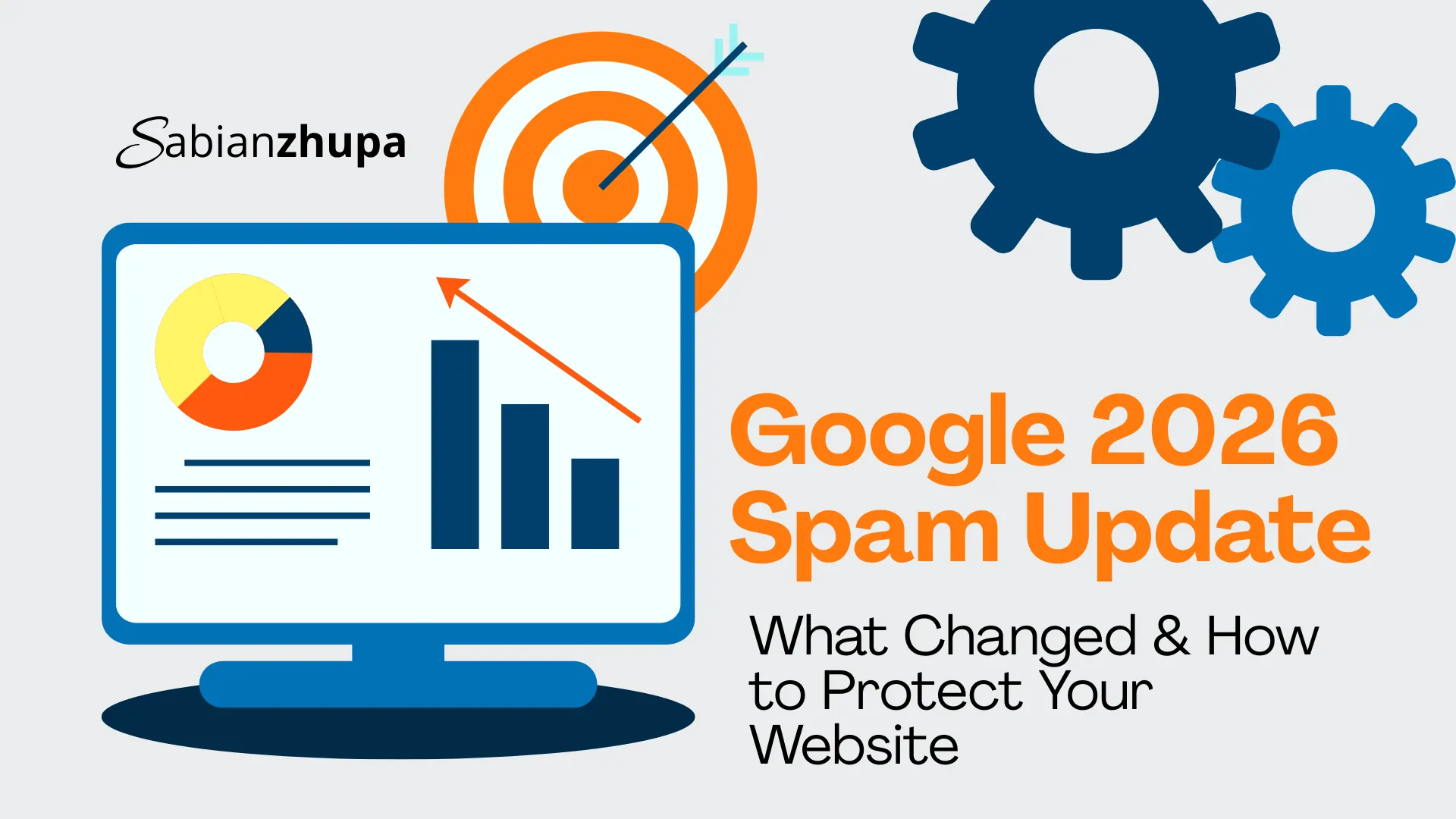
Google has made it clear: spammy websites have no place in its search results. With the first spam update of 2026 already rolled out, website owners and SEO professionals are asking the same question: was my site affected, and what should I do about it?
In this guide, I am going to break down everything you need to know about the Google 2026 spam update. From what Google actually changed, to how their AI-powered spam detection system SpamBrain works, to the exact steps you should take right now to audit your website and protect your organic traffic.
Whether you are a business owner managing your own website, a freelancer building sites for clients, or an SEO consultant navigating algorithm changes, this post will give you a practical, no-nonsense roadmap to stay on the right side of Google’s evolving spam enforcement.
What Is the Google 2026 Spam Update?
On March 24, 2026, Google officially released the March 2026 spam update. According to the Google Search Status Dashboard, the rollout began at 12:00 PM PT and was completed by March 25 at 7:30 AM PT, making it the fastest spam update in Google’s dashboard history at under 20 hours.
Google confirmed the update through their Google Search Central LinkedIn page, stating:
“Today we released the March 2026 spam update to Google Search. This is a normal spam update, and it will roll out for all languages and locations.”
This is the second algorithm update announced in 2026, following the February 2026 Discover core update. While Google described it as a “normal” spam update, it is important to understand that even standard updates can cause significant ranking shifts for sites that violate spam policies.
Spam Update vs. Core Update: What Is the Difference?
Before diving deeper, let me clarify a common point of confusion. Many website owners mix up spam updates and core updates, but they serve fundamentally different purposes.
A core update re-evaluates how Google assesses content quality across the web. When a core update rolls out, sites can gain or lose rankings based on how well their content meets updated quality standards, even if they have not violated any guidelines. Core updates are about relevance and quality, not penalties.
A spam update, on the other hand, specifically targets websites that violate Google’s spam policies. These updates improve the detection capabilities of systems like SpamBrain, Google’s AI-based spam prevention engine, to better identify and penalize manipulative tactics such as cloaking, link schemes, keyword stuffing, and scaled content abuse.
Here is a side-by-side comparison to make the distinction clearer:
| Factor | Core Update | Spam Update |
|---|---|---|
| Purpose | Re-assess content quality and relevance | Detect and penalize spam policy violations |
| Who is affected | Any site, even those following guidelines | Only sites violating spam policies |
| Type of impact | Rankings shift based on quality signals | Penalties, demotions, or removal from results |
| Recovery path | Improve content depth, E-E-A-T, and UX | Fix violations and wait for re-evaluation |
| Recovery timeline | Next core update cycle (weeks to months) | 3 to 6+ months after fixing violations |
| Google system involved | Broad ranking algorithms | SpamBrain (AI spam detection) |
The key takeaway: if your website follows Google’s guidelines and provides genuine value to users, a spam update should not negatively affect you. If your site relies on shortcuts and manipulative techniques, however, a spam update is exactly what catches up to you.
A Brief History of Google Spam Updates
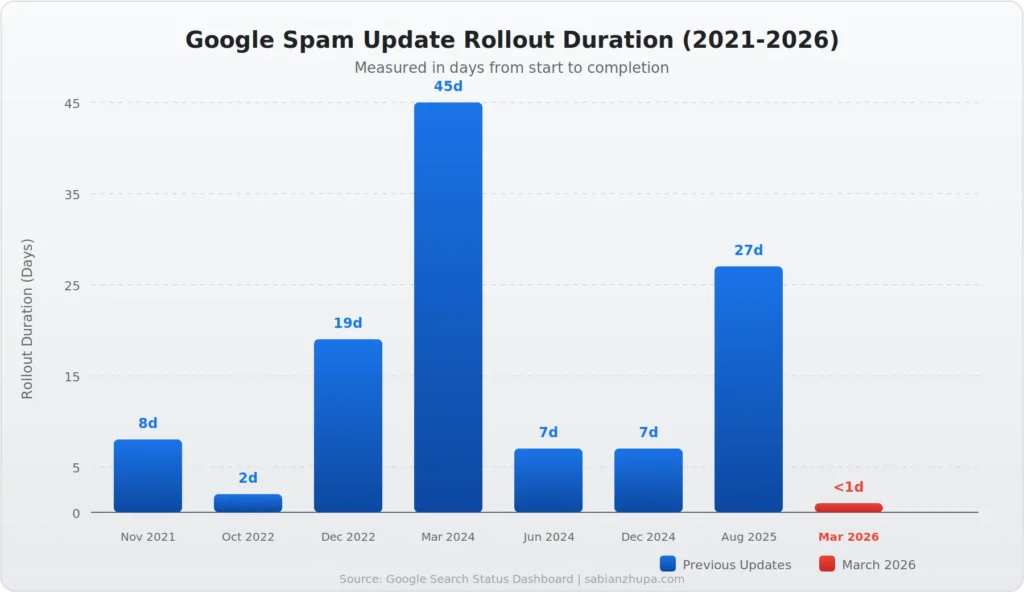
Understanding where the 2026 spam update fits in the larger picture helps you appreciate Google’s trajectory of increasingly sophisticated enforcement. Here is a timeline of recent spam updates:
| Update | Date | Rollout Duration | Key Focus |
|---|---|---|---|
| November 2021 Spam Update | Nov 3, 2021 | 8 days | General web spam |
| October 2022 Spam Update | Oct 19, 2022 | 48 hours | General web spam |
| December 2022 Link Spam Update | Dec 14, 2022 | 19 days | Link manipulation |
| October 2023 Spam Update | Oct 2023 | Multiple days | Multiple spam categories |
| March 2024 Spam Update | Mar 2024 | 45 days | Scaled content abuse, expired domain abuse, site reputation abuse (NEW policies) |
| June 2024 Spam Update | Jun 2024 | Multiple days | Reinforced March 2024 policies |
| December 2024 Spam Update | Dec 2024 | 7 days | General spam enforcement |
| August 2025 Spam Update | Aug 26, 2025 | 27 days | Penalty-focused, spammy domains lost visibility |
| March 2026 Spam Update | Mar 24, 2026 | Under 20 hours | Fastest rollout on record, global enforcement |
The pattern is clear: Google is getting faster and more efficient at detecting spam, and each update builds upon the last. This means that if your site has accumulated spam signals over time, the window to fix them before the next update is shrinking.
What Does the Google 2026 Spam Update Target?
Google did not publish a companion blog post or announce new spam policy categories with the March 2026 update. This means the existing spam policies remain the framework for evaluating any impact. Based on Google’s official documentation and patterns from previous updates, the following spam tactics are the primary enforcement targets:
1. Cloaking and Sneaky Redirects
Cloaking is the practice of showing different content to Google’s crawler than what actual users see on the page. This includes inserting hidden text or keywords visible only to search engine bots, or redirecting users to a different page than what Google indexed. If your website uses any form of deceptive content delivery, you are at direct risk.
2. Link Spam
Link spam remains one of the most heavily enforced categories. This includes buying or selling links for ranking purposes, participating in link exchange schemes, using automated tools to generate backlinks, and embedding hidden links within content. Google’s stance on link spam carries a critical distinction that every website owner should understand: once Google identifies and neutralizes spammy links, any ranking benefit those links provided is permanently lost and cannot be regained. Unlike content-based spam violations, link spam penalties are essentially irreversible in terms of recovering the specific gains those links provided.
3. Keyword Stuffing
Filling pages with repetitive keywords or phrases in an unnatural way continues to be a direct spam policy violation. This includes blocks of text listing cities or regions for local SEO manipulation, repeating the same phrases excessively, and lists of phone numbers or data without meaningful context. If your content reads unnaturally or feels forced with keywords, it is time to rewrite it with user intent in mind.
4. Scaled Content Abuse
This policy, introduced in March 2024, targets the mass production of low-quality content, whether generated by AI tools, templates, or manual processes, that exists primarily to manipulate search rankings rather than serve users. With the explosion of AI content generation tools, Google’s enforcement in this area has only intensified. A 16-month experiment covered by Search Engine Land found that while AI-generated content can get indexed quickly, rankings typically collapse within months without genuine authority, unique insight, and trust signals.
5. Site Reputation Abuse (Parasite SEO)
This refers to the practice of publishing irrelevant or low-quality third-party content on a high-authority domain purely to exploit that domain’s ranking power. Think coupon pages on news websites, or sponsored content sections that exist solely for SEO benefit. Google has been actively refining its ability to detect these arrangements since the policy was introduced in 2024.
6. Expired Domain Abuse
Purchasing an expired domain and repurposing it to leverage its pre-existing authority for manipulative purposes is another clearly defined violation. If you acquired a domain primarily because of its backlink profile or domain authority rather than its relevance to your actual business, you are operating in risky territory.
7. Other Violations
Additional spam policies include doorway abuse (creating pages targeting similar keywords to funnel traffic), hidden text and link abuse, thin affiliate content, scraped content, and misleading functionality. You can review the complete list on Google’s official spam policies page.
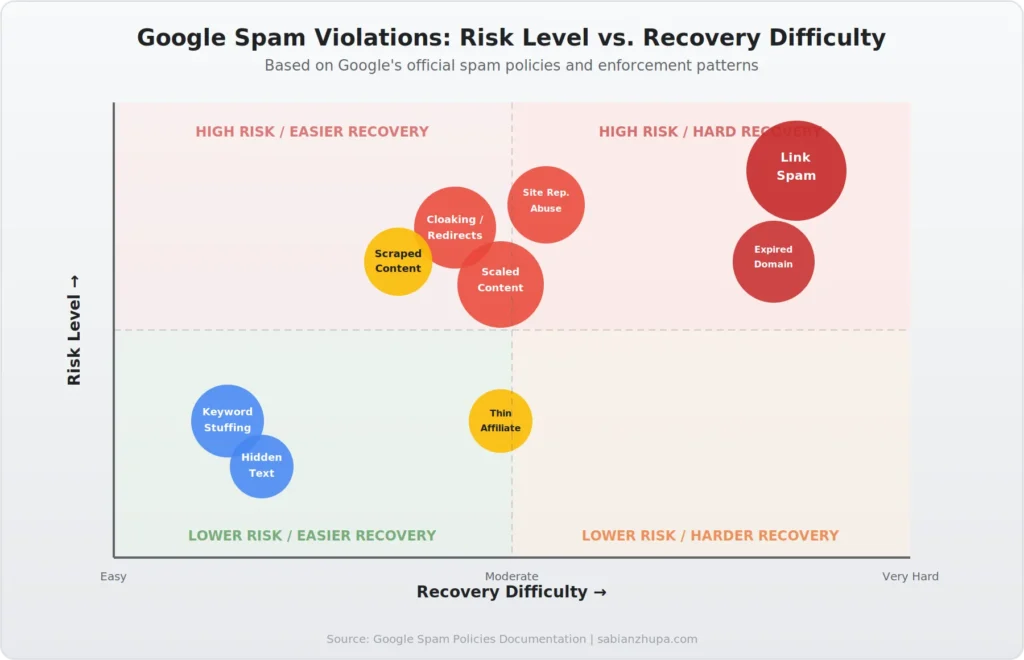
Spam Violations at a Glance: Risk Level and Recovery Difficulty
Not all spam violations carry the same weight. Some are easier to fix than others, and the recovery timeline varies significantly depending on the type of violation. Here is a breakdown to help you assess where your biggest risks might be:
| Spam Type | Risk Level | Recovery Difficulty | Can Rankings Be Fully Restored? |
|---|---|---|---|
| Cloaking / Sneaky Redirects | High | Moderate | Yes, after fixing and re-evaluation |
| Link Spam (bought/artificial links) | Very High | Very Hard | No. Link-based gains are permanently lost |
| Keyword Stuffing | Moderate | Easy | Yes, after rewriting content naturally |
| Scaled Content Abuse (mass AI content) | High | Moderate | Yes, with significant content improvement |
| Site Reputation Abuse (Parasite SEO) | High | Moderate | Yes, after removing third-party content |
| Expired Domain Abuse | High | Very Hard | Unlikely. May require moving to a new domain |
| Hidden Text / Link Abuse | Moderate | Easy | Yes, after removing hidden elements |
| Thin Affiliate Content | Moderate | Moderate | Yes, with unique value-added content |
| Scraped Content | High | Moderate | Yes, after replacing with original content |
How to Check If Your Website Was Affected
Before making any changes to your site, you need to confirm whether the spam update actually impacted you. Traffic drops can have many causes like seasonal patterns, technical issues, or server problems. Misdiagnosing the cause wastes valuable time.
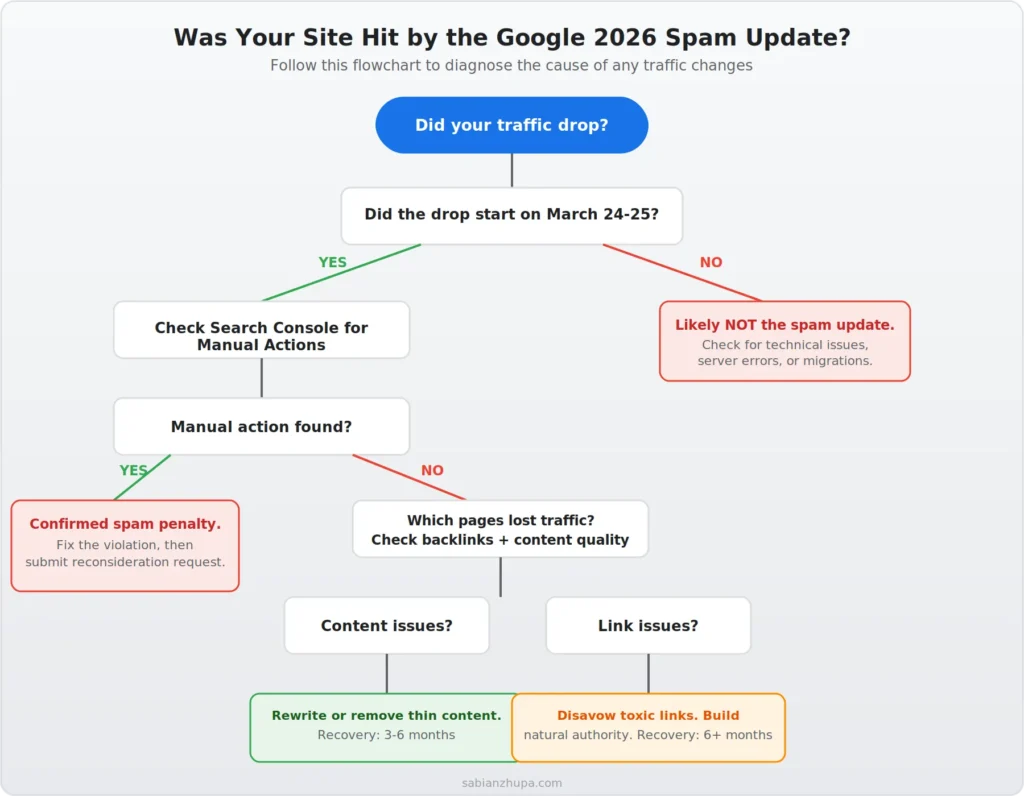
Here is a step-by-step process to determine if the Google 2026 spam update affected your website:
Step 1: Check Google Search Console
Open Google Search Console and navigate to Performance → Search results. Compare data from March 17–23 (before the update) against March 24–30 (during and after the update). Look for significant drops in impressions, clicks, or average position.
Step 2: Identify Affected Pages
Filter your performance data by Pages and sort by the largest traffic decline. Take note of which specific URLs lost the most visibility. Cross-reference those pages with areas of your site that may have questionable backlinks, thin content, or over-optimized keyword usage.
Step 3: Check for Manual Actions
In Google Search Console, go to Security & Manual Actions → Manual Actions. If Google has identified a specific spam policy violation on your site, it will appear here with details about what was found and which pages are affected.
Step 4: Verify with Third-Party Tools
Tools like Semrush, Ahrefs, and Sistrix provide daily ranking data and visibility trends. Compare your domain’s visibility score before and after March 24. If you see a sharp drop that aligns with the update timeline, the spam update is likely the cause.
Step 5: Rule Out Technical Issues
If your traffic dropped before March 24, or if the decline is gradual rather than sudden, technical issues are more likely the cause than the spam update. Check for server errors, crawl issues, broken redirects, or recent site migrations that could explain the drop.
Quick Diagnostic Summary
Use this table as a quick reference to identify whether the spam update is the likely cause of any traffic changes you are seeing:
| What You Are Seeing | Likely Cause | What to Do |
|---|---|---|
| Sharp traffic drop on March 24-25 | Google 2026 spam update | Audit backlinks and content for spam violations |
| Gradual decline over weeks | Technical issues or content quality | Run a technical SEO audit and check Core Web Vitals |
| Drop only on specific pages | Those pages may have spam signals | Review those pages for thin content, keyword stuffing, or unnatural links |
| Manual action notice in Search Console | Confirmed spam violation | Fix the violation and submit a reconsideration request |
| No change in traffic | Your site is not affected | Continue monitoring and maintain best practices |
| Traffic increased after March 24 | Competitors may have been penalized | Capitalize by strengthening your content and authority |
How to Recover from a Google Spam Penalty
If you have confirmed that the 2026 spam update impacted your website, recovery is possible, but it requires patience and genuine effort. There are no shortcuts.
For Content-Related Spam Violations
If your site was penalized for issues like keyword stuffing, scaled content abuse, or thin content, the path forward involves identifying and removing or substantially rewriting the offending content. Every page on your site should provide genuine value to users. If it does not, either improve it significantly or remove it entirely.
After making changes, wait for Google’s automated systems to re-evaluate your site. This process typically takes 3 to 6 months. There is no way to accelerate it. If you received a manual action, submit a reconsideration request through Search Console after fixing the issues.
For Link-Related Spam Violations
This is where things get more difficult. Google has been explicit: when their systems remove the ranking benefit of spammy links, those gains are permanently lost. Disavowing toxic backlinks through Google’s Disavow Tool can help prevent further damage, but it will not restore rankings that were artificially inflated by those links.
The long-term solution is to build genuine authority through high-quality content, earned backlinks from reputable sources, and a strong brand presence across the web.
Content Spam vs. Link Spam Recovery: Key Differences
Many website owners treat all spam penalties the same way, but the recovery process is very different depending on the type of violation. Here is a comparison:
| Factor | Content Spam Recovery | Link Spam Recovery |
|---|---|---|
| Can you recover? | Yes, by improving or removing bad content | Partially. Lost link-based gains are permanent |
| Timeline | 3 to 6 months after fixes | 6+ months, often longer |
| Action required | Rewrite, improve, or remove low-quality pages | Disavow toxic links, build natural authority over time |
| Tools to use | Google Search Console, Screaming Frog, manual review | Google Disavow Tool, Ahrefs, Semrush backlink audit |
| Prevention | Focus on E-E-A-T, original expertise, user value | Only earn links through quality content and outreach |
How to Protect Your Website from Future Spam Updates
The best strategy for handling any Google algorithm update, whether spam or otherwise, is to never need to recover from one in the first place. Here is how to build a website that is resilient against spam enforcement:
1. Audit Your Backlink Profile Regularly
Use tools like Semrush or Ahrefs to review your backlink profile at least quarterly. Look for links from low-quality directories, link farms, foreign-language spam sites, or Private Blog Networks (PBNs). Disavow any links that look unnatural or that you did not earn through genuine content and outreach.
2. Create Content That Serves Users First
Every piece of content on your website should answer a real question, solve a real problem, or provide genuine insight. If you are using AI tools to assist with content creation, make sure the output is reviewed, edited, and enhanced with original expertise and experience. Google does not penalize AI-assisted content. What it penalizes is low-quality, mass-produced content regardless of how it was created.
As an SEO consultant and web developer, I always advise my clients to focus on creating content that demonstrates real experience and expertise. This aligns directly with Google’s E-E-A-T framework (Experience, Expertise, Authoritativeness, Trustworthiness), which is the foundation of how Google evaluates content quality.
3. Maintain Clean Technical SEO
Ensure your website does not accidentally trigger spam signals through technical issues. This includes verifying that your site does not serve different content to Googlebot than to users (cloaking), fixing broken redirects that could be interpreted as sneaky redirects, removing hidden text or links in your CSS or HTML, and ensuring proper canonicalization across your pages.
If you are unsure about the technical health of your website, a professional SEO audit can identify issues before they become penalties.
4. Avoid Link Schemes
Do not buy links. Do not participate in link exchange networks. Do not use automated link building tools. Instead, focus on earning links naturally through creating valuable, shareable content, guest posting on relevant and reputable sites (for genuine expertise sharing, not just links), building relationships with journalists and bloggers in your industry, and creating original research, data, or tools that others want to reference.
5. Monitor Google’s Algorithm Update History
Stay informed about Google’s update schedule by following the Google Search Status Dashboard and trusted industry sources like Search Engine Land and Search Engine Journal. When an update rolls out, monitor your Search Console data and be ready to respond if you see unexpected changes.
What SpamBrain Means for SEO in 2026
SpamBrain is Google’s AI-powered spam detection system. It operates continuously in the background, but spam updates represent significant improvements to its capabilities. With each update, SpamBrain becomes better at identifying both the sites that produce spam and the sites that benefit from spammy practices, including sites that buy or sell links.
In 2026, SpamBrain’s capabilities have expanded significantly. It can now detect patterns across networks of sites that engage in coordinated spam behavior, identify AI-generated content that exists solely to manipulate rankings, and recognize link patterns that indicate manipulation rather than genuine authority.
For website owners, this means that tactics which may have worked years ago, or even months ago, are increasingly likely to be caught and penalized. The sophistication of Google’s spam detection grows with every update, making sustainable, quality-focused SEO the only viable long-term strategy.
The Bigger Picture: Google Algorithm Updates in 2026
The March 2026 spam update does not exist in isolation. It is part of a broader pattern of algorithm changes that Google has rolled out this year:
- February 2026 Discover Core Update: The first core update of 2026, specifically scoped to Google Discover. This update adjusted how content quality is evaluated for Discover feeds, running from February 5 to February 27.
- March 2026 Spam Update: The first spam update of 2026, targeting sites violating spam policies across all languages and regions.
Together, these updates signal that Google is simultaneously raising the bar for content quality (through core updates) and cracking down on manipulative tactics (through spam updates). Sites that want to maintain and grow their organic visibility need to excel on both fronts.
For a deeper look at how I approach building websites and SEO strategies that are resilient to algorithm changes, you can learn more about my work and philosophy here.
Key Takeaways
The Google 2026 spam update reinforces principles that have been true for years but are now more aggressively enforced than ever. Here is what you should take away from this update:
If your traffic stayed stable or improved, your SEO strategy is built on solid foundations. Keep doing what you are doing, but stay vigilant and continue monitoring your site’s performance.
If your traffic dropped, do not panic. Systematically audit your site using the steps outlined above. Identify whether the issue is content-related or link-related, and take the appropriate corrective action. Recovery takes months, not days, so commit to the process.
If you are building a new website, start with clean foundations. Focus on original, expert-driven content, a natural backlink profile, and technical excellence. The cost of fixing spam-related penalties far outweighs the investment in doing things right from the start.
Google’s message is consistent and clear: build websites for users, not for search engines. The sites that internalize this principle are the ones that thrive through every algorithm update, spam or otherwise.
If you need help auditing your website, fixing technical SEO issues, or building a strategy that protects your rankings long-term, feel free to reach out for a free consultation. I work with businesses and individuals to build websites and SEO strategies that deliver lasting results. You can see examples of my work in my portfolio.
References
- Google Search Status Dashboard: March 2026 Spam Update
- Google Search Central: Spam Policies for Google Web Search
- Search Engine Land: Google Releases March 2026 Spam Update
- Search Engine Journal: Google Begins Rolling Out the March 2026 Spam Update
- Search Engine Roundtable: Google March 2026 Spam Update Unleashed