


If you’ve been following AI developments in 2026, you’ve probably noticed a shift. The conversation has moved beyond chatbots and content generators toward something far more powerful: agentic AI, autonomous systems that can plan, decide, and execute multi-step business workflows with minimal human intervention.
This isn’t a futuristic concept anymore. According to Gartner, 40% of enterprise applications will embed task-specific AI agents by the end of 2026, up from less than 5% in early 2025. The global market has crossed the $10 billion mark, and companies across healthcare, finance, retail, and manufacturing are reporting measurable returns.
But here’s the catch: while adoption is surging, over 40% of agentic AI projects are at risk of cancellation by 2027 if businesses don’t establish proper governance and ROI frameworks. This guide breaks down everything you need to know, backed by the latest data, so you can make informed decisions about where agentic AI fits in your digital strategy.
What Is Agentic AI? (And How It Differs from Generative AI)
Agentic AI refers to artificial intelligence systems that exhibit autonomous decision-making capabilities, goal-directed behavior, and long-term planning. Unlike generative AI tools (such as ChatGPT or Midjourney) that react to prompts and produce content, agentic AI proactively initiates actions, adapts to new environments, and can self-correct without requiring explicit instructions at every step.
Think of the difference this way: generative AI is like having a skilled intern who does exactly what you ask. Agentic AI is like having a project manager who understands the goal, breaks it down into tasks, uses the right tools, coordinates with other systems, and delivers the result, only asking for your approval when necessary.
Generative AI vs. Agentic AI: Key Differences
| Feature | Generative AI | Agentic AI |
|---|---|---|
| Behavior | Responds to prompts | Pursues goals autonomously |
| Task Scope | Single-task output | Orchestrates multi-step workflows |
| Memory | No persistent memory | Learns from feedback & retains context |
| Initiative | Human initiates every action | Takes initiative within defined boundaries |
| Capability | Creates content on demand | Executes actions across multiple systems |
| Example | ChatGPT drafting an email | AI agent researching, drafting, sending, and following up on emails autonomously |
Major tech companies are already deploying agentic architectures at scale. Microsoft’s AutoGen platform allows multiple AI agents to collaborate on enterprise-wide objectives, spanning customer service, sales, and technical support, all sharing context and coordinating autonomously. Google Cloud now offers agentic AI capabilities that orchestrate end-to-end workflows semi-autonomously, and Salesforce has positioned its Agentforce platform as a core product for 2026.
Agentic AI Market Size & Growth Data
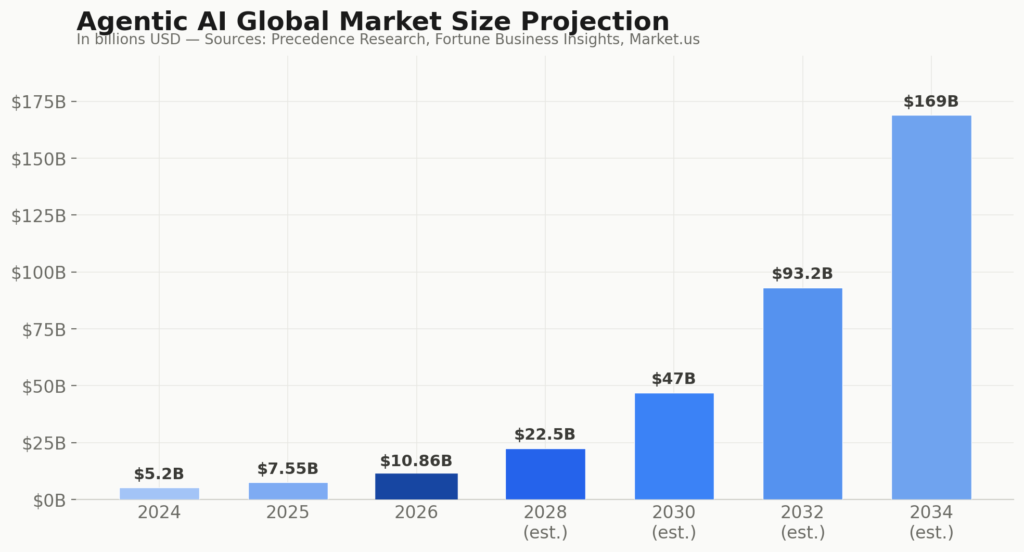
The numbers tell a compelling story. The agentic AI market is one of the fastest-growing technology categories since cloud infrastructure first exploded between 2009 and 2012, according to Gartner’s 2026 Market Forecast. Spending velocity is roughly 340% higher than what we saw during robotic process automation’s peak growth period.
Here’s how the market has evolved and where it’s heading:
Agentic AI Market Size by Year
| Year | Market Size (USD) | YoY Growth | Source |
|---|---|---|---|
| 2024 | $5.2 billion | N/A | Market.us |
| 2025 | $7.55 billion | +45.2% | Precedence Research |
| 2026 | $10.86 billion | +43.8% | Precedence Research |
| 2028 (est.) | $22.5 billion | ~44% CAGR | Markets & Markets |
| 2030 (est.) | $47+ billion | ~44% CAGR | Capgemini / Statista |
| 2032 (est.) | $93.2 billion | ~44.6% CAGR | Markets & Markets |
| 2034 (est.) | $139 to $199 billion | ~40 to 44% CAGR | Fortune / Precedence |
Venture capital investment is equally aggressive. In 2023, agentic AI startups raised just over $1.3 billion. By 2025, that figure surpassed $40 billion in North America alone. Foundation model companies like OpenAI and Anthropic are raising massive growth rounds at $20+ billion valuations, while application-layer startups are demonstrating real product-market fit and graduating from seed funding to growth-stage rounds.
“AI agents and robots could generate an estimated $2.9 trillion in annual economic value in the US alone.”
McKinsey & Company
Enterprise Adoption Rates by Industry
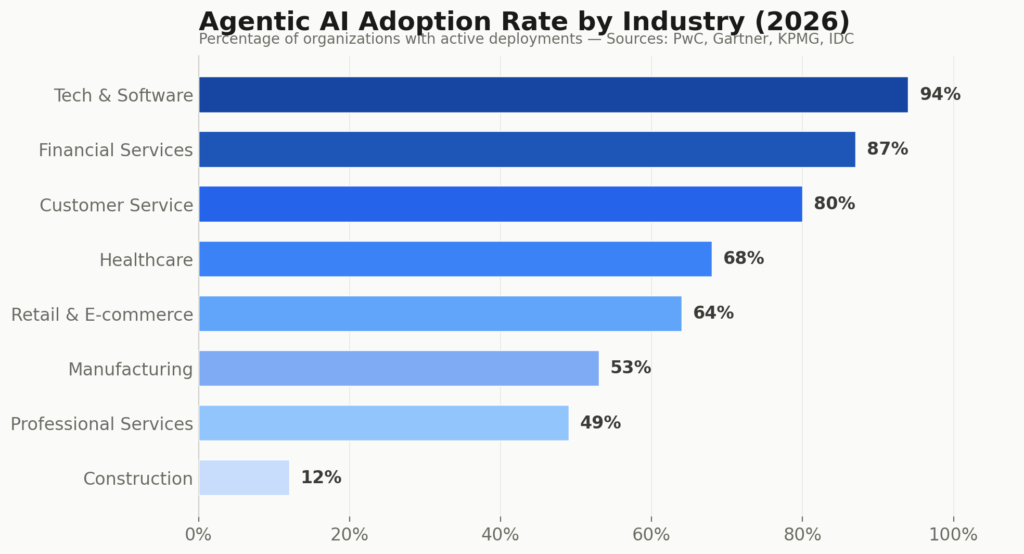
Adoption varies significantly across sectors. Customer service and e-commerce lead the pack because the ROI case is straightforward: high ticket volumes, predictable intents, and clearly measurable KPIs. Healthcare and financial services are also investing heavily, though they move more cautiously due to regulatory complexity.
Here’s a breakdown of where things stand based on multiple research reports from PwC, Gartner, IDC, and McKinsey:
Agentic AI Adoption & ROI by Industry
| Industry | Adoption Rate | Top Use Case | Average ROI |
|---|---|---|---|
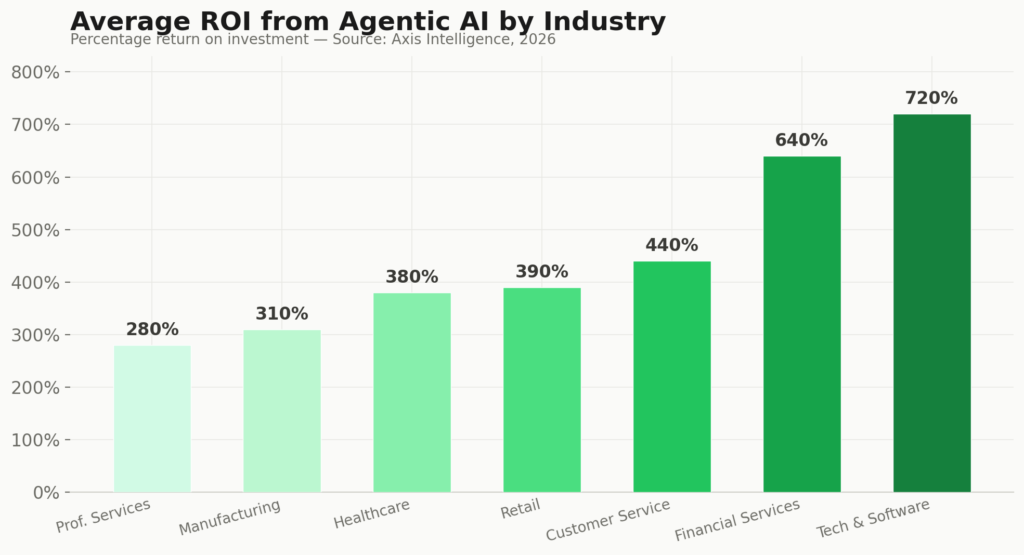
| Technology & Software | 94% | Code generation, DevOps | 720% |
| Financial Services | 87% | Fraud detection, trading | 640% |
| Customer Service | 80% | Triage, ticket resolution | 440% |
| Healthcare | 68% | Diagnostic assistance | 380% |
| Retail & E-commerce | 64% | Personalized shopping | 390% |
| Manufacturing | 53% | Predictive maintenance | 310% |
| Professional Services | 49% | Document analysis | 280% |
| Construction | 12% | Project management | TBD |
If you’re wondering which departments are deploying AI agents first, Zapier’s 2026 enterprise survey found that Customer Support leads at 49%, followed closely by Operations at 47%, Engineering at 35%, and Marketing at 31%. Even Sales and Finance, traditionally slower to adopt, are at 26% and 24% respectively.
Perhaps the most telling statistic: 84% of enterprise leaders say it’s likely or certain their organization will increase AI agent investments over the next 12 months. Only 2% said they’re certain they won’t.
Top Use Cases Driving Real ROI
Hype is one thing. Results are another. Let’s look at where agentic AI is actually delivering measurable value right now.
Top Agentic AI Use Cases in Production (2026)
| Use Case | Enterprise Deployment % | Real-World Example |
|---|---|---|
| Data management & entry | 47% | Automated data extraction, cleansing across systems |
| Document analysis & summarization | 41% | Contract review, report synthesis, compliance checks |
| Customer support triage | 41% | Autonomous ticket routing & first-response resolution |
| Report generation | 36% | Weekly performance dashboards, financial summaries |
| Code generation & testing | 35% | Automated QA, code reviews, bug detection |
| Fraud detection | 31% | Real-time transaction monitoring with 98.7% accuracy |
| Predictive maintenance | 28% | Equipment failure forecasting 96 hours in advance |
| Personalized marketing | 24% | Dynamic content & offer optimization at scale |
Here are some standout examples from real enterprise deployments that demonstrate the tangible impact of agentic AI:
Healthcare (AtlantiCare): Deployed an agentic AI clinical assistant for ambient note generation. Among the 50 providers who tested it, they saw an 80% adoption rate and a 42% reduction in documentation time, saving roughly 66 minutes per provider per day.
Financial Services (JPMorgan): Their contract analysis agents now review over 23,000 commercial agreements annually, identifying contractual risks that human lawyers missed in 19% of reviewed cases.
Manufacturing (Siemens): Industrial agents monitor over 340,000 sensors across production facilities, predicting equipment failures 96 hours in advance with 91% accuracy. The result: touchless processing rates reached 90%, delivering approximately €5 million in annual savings.
Logistics (DHL): Optimization agents dynamically reroute 14,000 daily shipments based on weather, traffic, fuel prices, and delivery timelines. Transportation costs dropped by 18%, while on-time delivery improved from 89% to 96%.
These aren’t pilot programs. They’re production systems delivering measurable business impact. If you’re exploring how AI could transform your own operations, it’s worth starting a conversation with a strategist who understands both the technology and the business implications.
ROI Benchmarks: What Returns Can You Expect?
This is the section that matters most to decision-makers. Is agentic AI actually paying for itself?
The data says yes, but with caveats. According to a multi-industry survey compiled by Axis Intelligence and corroborated by McKinsey, about 62% of organizations using AI agents report they expect returns above 100% on their investments, with the average expectation landing around 171%.
Key investment data points that paint the full picture:
| Investment Metric | Value | Source |
|---|---|---|
| Organizations increasing AI investment in 2026 | 82% | ServiceNow AI Maturity Index |
| Enterprise leaders increasing agent-specific budgets | 84% | Zapier Enterprise Survey |
| Senior leaders planning $10M+ agentic AI spend | 35% | Industry Reports |
| Healthcare execs expecting 10%+ cost savings | 98% | Deloitte 2026 Health Care Outlook |
| Healthcare execs expecting 20%+ cost savings | 37% | Deloitte 2026 Health Care Outlook |
| Organizations expecting returns above 100% | 62% | Axis Intelligence / McKinsey |
In healthcare specifically, Deloitte’s 2026 US Health Care Outlook Survey found that over 80% of health care executives expect both agentic AI and generative AI to deliver moderate-to-significant value across clinical, business, and back-office functions in 2026. And 61% of respondents say they’re already building and implementing agentic AI initiatives or have secured dedicated budgets.
Why 40% of Agentic AI Projects Still Fail
Despite the promising ROI data, the reality check is important: only about 11% of pilot projects actually make it into full production, and Gartner warns that over 40% of agentic AI projects are at risk of cancellation by 2027. Understanding why projects fail is just as important as understanding what success looks like.
Top Barriers to Agentic AI Deployment
| Challenge | % of Orgs Affected | Description |
|---|---|---|
| Integration complexity | 58% | Enterprise environments involve 50–200+ systems requiring integration |
| Data infrastructure gaps | 47% | Fragmented data silos prevent unified agent access |
| Unclear ROI metrics | 43% | Difficulty proving business value and defining KPIs before deployment |
| Governance & compliance | 39% | Regulatory uncertainty around autonomous AI decision-making |
| Talent scarcity | 34% | Global shortage of 340,000+ AI/ML engineers |
| Security & privacy concerns | 31% | Prompt injection risks, data protection, and access control |
The interoperability issue is especially critical. In a UiPath study of over 500 IT executives, 87% rated interoperability as “very important” or “crucial” to successful agentic AI adoption. AI agents don’t operate in isolation. They need to coordinate across your CRM, ERP, email, databases, and third-party platforms. Without solid integration architecture, even the most sophisticated agent is useless.
Another concern that’s slowing enterprise adoption: the human workforce impact. A decline in entry-level hiring to 66% has been reported as organizations lean more heavily on AI agents for junior-level tasks. While agentic AI is augmenting teams rather than replacing them in most cases, the shift requires proactive change management.
If you’re planning an AI initiative and want to avoid these pitfalls, having the right technical partner makes the difference between a pilot that fizzles and a deployment that scales.
How to Prepare Your Business for Agentic AI
Based on the data, and the patterns from companies that are succeeding, here’s a practical framework for getting started with agentic AI in your organization.
Step 1: Audit Your Workflows for Agent-Ready Tasks
Look for processes that are multi-step, rule-based, and high-volume. Customer service triage, invoice processing, data entry, and content scheduling are all strong candidates. The 47% of enterprises already using agents for data management didn’t start with ambitious AI transformations. They started with a single painful workflow and automated it.
Step 2: Fix Your Data Foundation
Since 47% of organizations cite data infrastructure as their biggest hurdle, invest in cleaning up fragmented silos before deploying agents. Data fabric architectures from platforms like Databricks and Snowflake can provide unified access without requiring full data consolidation. Your AI agents are only as good as the data they can access.
Step 3: Start Small, Measure Everything
The most common approach in 2026 remains human-in-the-loop. According to Zapier, 38% of enterprises of enterprises build approval gates into agent workflows so a human reviews outputs before they move downstream. Only 20% of enterprise leaders report their AI systems operate autonomously with minimal oversight. Measure time saved, error rates, and customer satisfaction from day one.
Step 4: Invest in Your Team
Your employees don’t need to become data scientists, but they do need AI literacy. Training on prompt engineering, understanding agent capabilities and limits, and workflow redesign are essential skills for 2026. As Harvard Business School professor Tsedal Neeley puts it, the key differentiator for organizations in the AI era is “change fitness,” the ability to adapt to constant, significant change.
Step 5: Choose the Right Architecture
Decide between single-agent systems (simpler, faster to deploy) and multi-agent orchestration (more powerful, more complex). In 2026, single-agent systems still hold about 58% of deployments because they’re easier to manage, but multi-agent architectures are growing faster at a 43.5% CAGR for complex enterprise workflows that require coordination across departments.
Not sure where to begin? Working with someone who understands both the technical and strategic side of implementation can save months of trial and error.
Which Departments Are Deploying AI Agents First?
One of the most practical questions business leaders ask is: “Where do we start?” The department-level data provides a clear answer.
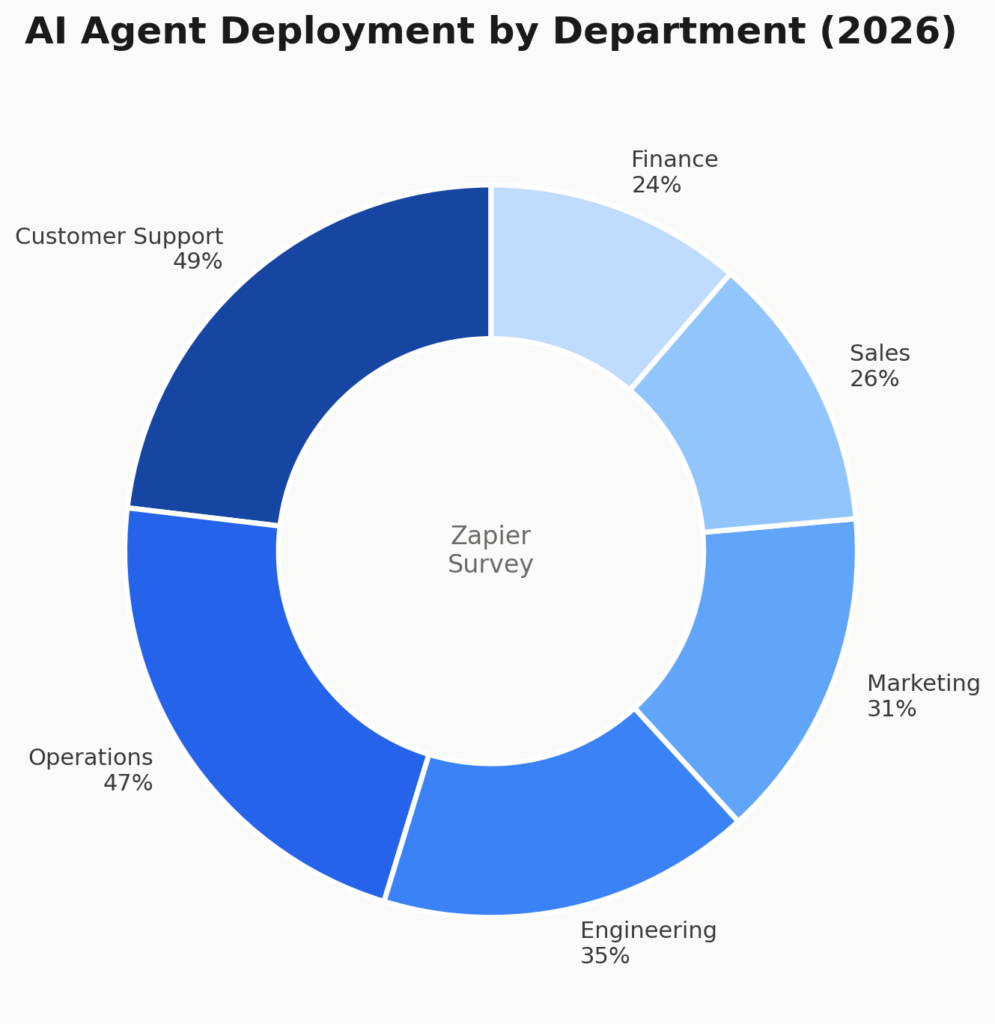
Customer Support (49%) and Operations (47%) are the clear frontrunners. These departments handle high volumes of repetitive, rule-based tasks where AI agents deliver immediate, measurable value. Engineering (35%) follows as development teams adopt AI coding assistants and automated testing. Marketing sits at 31%, with agents handling content scheduling, campaign optimization, and reporting.
Looking ahead at planned deployments, the picture gets even more interesting. Master of Code Global reports that cybersecurity and support desk teams lead future deployment plans at 38% each, followed by software development (36%), customer service (34%), and IT (30%). HR (28%), compliance (26%), product management (25%), marketing (24%), and sales (22%) round out the list, showing that agentic AI is spreading across every business function.
What’s Next: Predictions for 2027 and Beyond
Looking at the trajectory of adoption and investment, here’s where the agentic AI landscape is heading:
Multi-agent orchestration becomes the norm. By 2027, we’ll see coordinated “agent teams” managing entire business functions, from lead generation through sales to post-sale support, with humans supervising strategy rather than individual tasks. Microsoft’s AutoGen and similar frameworks are already enabling this at scale.
Vertical-specific agents dominate. Vertical AI solutions already captured 34% of market share in early 2026, up from 12% in 2025. Industry-specific agents trained on healthcare compliance (HIPAA), financial regulations, or manufacturing safety protocols will consistently outperform general-purpose tools. A healthcare scheduling agent that understands compliance will always beat a generic AI assistant.
Regulation catches up and accelerates adoption. The SEC, CFPB, and European regulators are finalizing AI governance frameworks during 2026. Counter-intuitively, clear regulatory guidelines will actually accelerate adoption by reducing the deployment uncertainty that has slowed cautious industries like financial services and healthcare.
The “agent economy” creates entirely new roles. Just as the web created roles like UX designer and growth marketer, agentic AI will create demand for agent architects, AI workflow designers, and AI governance specialists. IDC predicts that around 40% of roles in Global 2000 companies will involve direct engagement with AI agents by end of 2026.
Open-source agents level the playing field. Smaller, domain-specific models are achieving impressive results, from IBM’s Granite to DeepSeek’s models. Advances in fine-tuning and reinforcement learning mean SMEs can now adopt AI agents without enterprise-scale budgets, making “agent-as-a-service” offerings increasingly accessible.
Key Agentic AI Statistics at a Glance (2026)
For quick reference, here’s a summary of the most important agentic AI data points for 2026:
| Metric | Value | Source |
|---|---|---|
| Global agentic AI market size (2026) | $10.86 billion | Precedence Research |
| Projected market size by 2034 | $139–$199 billion | Fortune Business Insights / Precedence |
| Compound annual growth rate (CAGR) | 43.8% | Market.us |
| Enterprise apps with embedded AI agents | 40% (up from <5%) | Gartner |
| Organizations with some AI agent adoption | 79% | PwC 2025 Survey |
| Enterprise leaders increasing AI agent investment | 84% | Zapier |
| Organizations expecting to increase AI spend | 82% | ServiceNow |
| Organizations experimenting with or scaling agents | 62% experimenting, 23% scaling | McKinsey |
| Pilot-to-production success rate | ~11% | Industry Aggregate |
| Projects at risk of cancellation by 2027 | 40%+ | Gartner |
| IT execs rating interoperability as crucial | 87% | UiPath |
| Estimated US economic value from AI agents | $2.9 trillion annually | McKinsey |
| North America market share | 33–40% | Fortune / Grand View Research |
| Cloud-based deployment share | 62% | Precedence Research |
Final Takeaway
Agentic AI is no longer an emerging concept. It is a measurable, rapidly scaling market that’s already reshaping how enterprises operate. The data is unambiguous: a $10.86 billion market growing at 44% annually, 84% of leaders increasing investment, and real-world deployments delivering 300–700% ROI across industries.
But the data also tells a cautionary story. With 58% of organizations struggling with integration complexity and only 11% of pilots reaching production, success depends not on having the most agents, but on having the right strategy, governance, and technical foundation.
The businesses that win in 2026 won’t be the ones that moved fastest. They’ll be the ones that moved most strategically. If you’re interested in building a digital presence that’s ready for the AI-driven future, explore how Sabian Zhupa can help, or check out real projects that demonstrate what’s possible when strategy meets execution.
Sources & References: Gartner • Precedence Research • Grand View Research • Market.us • McKinsey & Company • Zapier AI Agents Survey • Deloitte • Statista / Capgemini • Google Cloud AI Agent Trends 2026 • Fortune Business Insights • MIT Sloan Management Review • OneReach.ai • Master of Code Global • Cyntexa