If you’ve been optimizing for featured snippets over the past few years, here’s the hard truth: the SERP landscape you built your strategy around is disappearing. Google’s AI Overviews are steadily replacing featured snippets, and the data confirms that this isn’t a temporary experiment. It’s a permanent restructuring of how search results work.
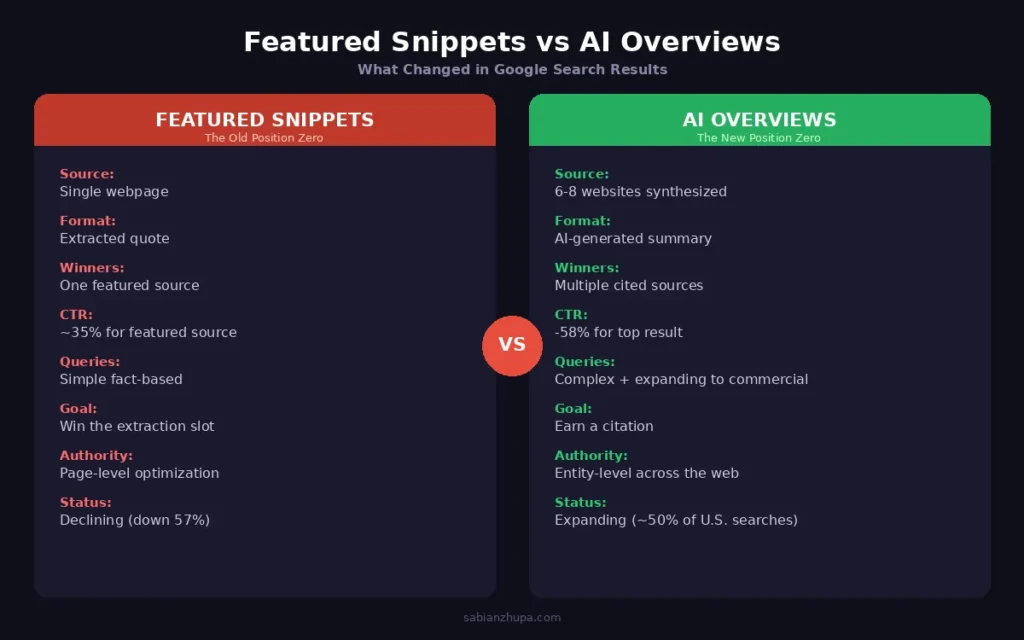
Featured snippet co-occurrence with AI Overviews has dropped from 34% to just 18% according to Semrush’s 10-million-keyword study. That means Google is actively choosing AI Overviews instead of featured snippets, not alongside them. For SEO professionals and business owners who invested heavily in “Position Zero” strategies, this shift demands immediate attention.
In this guide, I’ll walk you through the data behind this transition, explain what it means for your organic traffic, and give you seven actionable strategies to adapt your SEO approach for the AI Overview era. Whether you’re a seasoned digital marketing professional or a business owner trying to stay visible in search, this is the playbook you need right now.
What Are AI Overviews and Why Are They Replacing Featured Snippets?
Before diving into strategy, let’s clarify the fundamental difference between these two SERP features, because understanding this distinction is the key to adapting.
Featured snippets extract a short answer from a single webpage and display it at Position Zero, above the traditional organic results. They pull a paragraph, list, or table from one source and give that source prominent visibility. Featured snippets have been a cornerstone of SEO strategy since Google introduced them, and for good reason. They historically captured around 35% of clicks on queries where they appeared.
AI Overviews, on the other hand, synthesize information from multiple sources (typically six to eight) to generate an original, AI-written summary. They don’t extract content from a single page. Instead, they create a new answer by pulling from several websites, citing those sources as references beneath the summary.
The table below breaks down the core differences between these two features so you can clearly see what has changed and why it matters for your strategy.
| Feature | Featured Snippets | AI Overviews |
|---|---|---|
| Content Source | Extracted from a single webpage | Synthesized from 6-8 sources |
| Answer Format | Direct quote (paragraph, list, or table) | AI-generated original summary |
| Number of Winners | One featured source | Multiple cited sources |
| Click-Through Behavior | ~35% CTR for the featured source | 58% CTR reduction for top result |
| Query Types Served | Simple, fact-based questions | Complex, multi-part queries expanding into commercial |
| Optimization Goal | Win the single extraction slot | Earn a citation among trusted sources |
| Content Requirement | Best-formatted direct answer | Entity authority + structured, original content |
| Current SERP Prevalence | Declining (down 57% since Sept 2024) | Expanding (~50% of U.S. searches) |
This is a fundamentally different model. With featured snippets, there was one winner. With AI Overviews, there are multiple cited sources, but none of them get the full spotlight. It’s less about winning a single position and more about being one of the trusted voices Google’s AI chooses to reference.
The Data: Featured Snippets Are Declining Fast
Let’s look at what the numbers are actually telling us. Multiple large-scale studies published in late 2025 and early 2026 paint a consistent picture of featured snippet decline and AI Overview expansion.
Featured Snippet Prevalence Is Dropping
According to research from GSQI, featured snippet prevalence dropped by 57% between September 2024 and March 2025 as AI Overviews expanded across more query types. Semrush’s data further confirms this, showing that featured snippets and AI Overviews rarely appear together anymore. Their co-occurrence fell from over 34% down to roughly 18% by November 2025.
This isn’t a coincidence. Google appears to view AI Overviews as a replacement for featured snippets, not a complementary feature. When an AI Overview appears, the traditional featured snippet usually doesn’t.
AI Overviews Are Expanding Rapidly
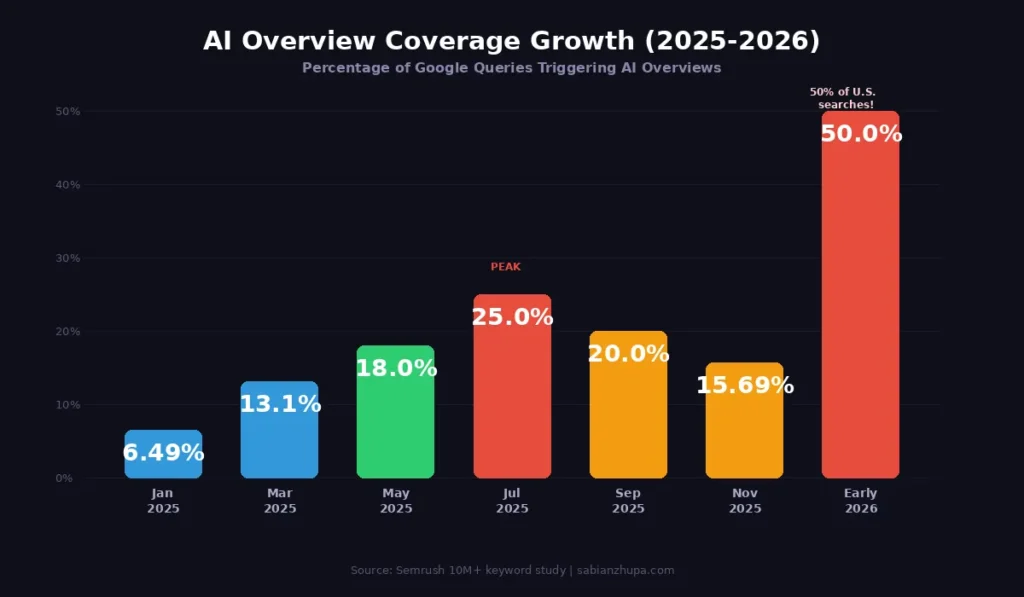
AI Overviews now appear in approximately 50% of U.S. searches, reaching 1.5 billion users monthly across more than 200 countries and territories. The coverage surged throughout 2025, jumping from 6.49% of queries in January to nearly 25% by July, before settling around 15-16% by November as Google fine-tuned the feature.
The table below shows how AI Overview coverage evolved month by month throughout 2025, based on Semrush’s analysis of over 10 million keywords.
| Time Period | AI Overview Coverage | Featured Snippet Co-occurrence | Key Observation |
|---|---|---|---|
| January 2025 | 6.49% | ~34% | Early rollout, mostly informational queries |
| March 2025 | 13.1% | ~28% | Featured snippet prevalence drops 57% |
| July 2025 (Peak) | ~25% | ~21% | Highest recorded AI Overview coverage |
| November 2025 | 15.69% | ~18% | Google pulls back, refines quality |
| Early 2026 | ~50% (U.S.) | Declining further | Expanding into commercial and transactional queries |
More importantly, AI Overviews are no longer limited to informational queries. Throughout 2025, the percentage of commercial, transactional, and navigational keywords triggering AI Overviews steadily grew. This means the shift isn’t just affecting top-of-funnel content. It’s creeping into the queries that directly drive revenue.
Click-Through Rates Are Taking a Hit
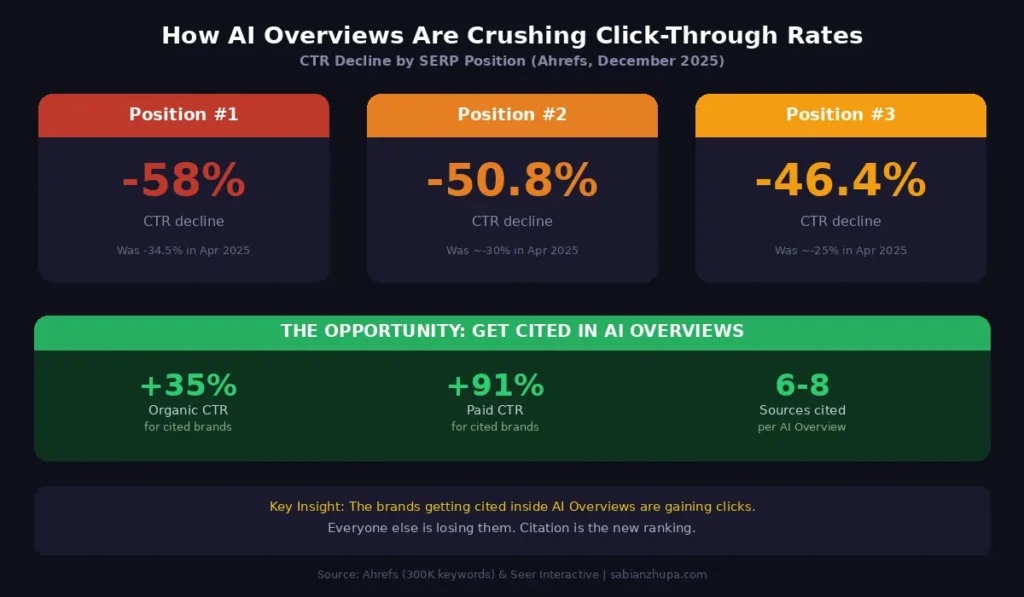
Ahrefs analyzed 300,000 keywords in December 2025 and found that AI Overviews caused a 58% reduction in click-through rate for the top-ranking organic result. This is significantly worse than the 34.5% drop measured just eight months earlier in April 2025, suggesting the impact is accelerating, not stabilizing.
Here’s a full breakdown of the CTR impact by ranking position, based on data from Ahrefs’ December 2025 study.
| SERP Position | CTR Drop (Apr 2025) | CTR Drop (Dec 2025) | Acceleration |
|---|---|---|---|
| Position #1 | -34.5% | -58% | +23.5 points worse |
| Position #2 | ~-30% | -50.8% | ~+20 points worse |
| Position #3 | ~-25% | -46.4% | ~+21 points worse |
| With AIO + Featured Snippet | -37% CTR for Position #1 | Worst combo for publishers | |
| Cited in AI Overview | +35% organic CTR, +91% paid CTR | The new opportunity | |
The bottom row of that table is the most important one. While overall CTR is declining, brands that actually get cited inside AI Overviews see dramatically higher click-through rates. This is why shifting your strategy from “winning the snippet” to “earning the citation” is so critical right now.
What This Means for Your SEO Strategy
If you’ve been building your SEO strategy around winning Position Zero, here’s the honest assessment: that specific tactic is becoming less relevant. But that doesn’t mean organic search is dead. It means the rules have changed, and the businesses that adapt fastest will capture the opportunities that others miss.
Here’s the critical mindset shift: in the featured snippet era, you optimized for a click. In the AI Overview era, you optimize for a citation.
Being cited as one of the sources in an AI Overview is the new Position Zero. Data from Seer Interactive shows that brands cited in AI Overviews enjoy 35% higher organic CTR and 91% higher paid CTR compared to non-cited brands on the same queries. Getting that citation isn’t just about visibility. It directly impacts whether users click through to your site.
7 Strategies to Win in the AI Overview Era
Now let’s get practical. Here are seven strategies you can implement immediately to maintain and grow your search visibility as AI Overviews replace featured snippets. These aren’t theoretical. They’re based on what the data shows actually works for earning AI citations.
1. Structure Content for AI Extraction, Not Just Human Reading
AI Overviews pull from content that is clearly structured and easy to parse. This means your content architecture matters more than ever. Use clear H2 and H3 headings that mirror the questions your audience asks. Place a direct, concise answer (40-60 words) immediately after each heading. Then expand with supporting detail, examples, and original insights below.
Think of it as the “inverted pyramid” approach: answer first, elaboration second. If Google’s AI has to dig through three paragraphs of preamble to find your actual answer, it won’t cite you. The brands that structure their content for immediate extraction are the ones showing up in AI Overviews consistently.
Implement schema markup strategically. FAQPage, HowTo, and Speakable schemas all help Google’s AI understand the structure of your content and identify extractable answers. While schema alone won’t guarantee a citation, it removes friction from the extraction process.
2. Build Multi-Source Authority (Not Just On-Page SEO)
Here’s something most SEOs haven’t fully grasped yet: AI Overviews don’t just evaluate your page in isolation. They evaluate your entity across the entire web. Google’s AI is looking at whether your brand appears consistently across trusted sources like Wikipedia mentions, industry publication citations, professional directory listings, social media authority, and peer recognition.
This is why building genuine expertise and authority matters more than ever. A well-structured page from an unknown brand will lose to a decently structured page from a recognized industry authority. Invest in digital PR, contribute to industry publications, maintain consistent NAP (Name, Address, Phone) data across platforms, and build your brand’s entity profile across the web.
3. Prioritize Original Data, Research, and First-Person Experience
AI Overviews have a strong preference for content that contains information you can’t find anywhere else. Original research, proprietary data, case studies with specific results, and genuine first-person experience are citation magnets. Generic, rewritten content that simply restates what everyone else has already said is exactly what AI Overviews are designed to bypass.
Ahrefs’ own analysis revealed that their most-cited content pieces were data studies built on proprietary datasets. If you can produce original statistics, run surveys, or share detailed case study results, your content becomes significantly more valuable to Google’s AI as a citation source.
This aligns perfectly with Google’s E-E-A-T framework, where the first “E” stands for Experience. Content that demonstrates you’ve actually done the thing you’re writing about carries more weight with both Google’s traditional algorithm and its AI systems.
4. Shift Your Keyword Strategy Toward Commercial and Transactional Intent
AI Overviews disproportionately appear on informational queries, specifically the “what is” and “how to” searches that historically drove featured snippet traffic. While AI Overviews are expanding into commercial queries, they still appear far less frequently for bottom-of-funnel, purchase-intent keywords.
To see exactly where AI Overviews are hitting hardest and where the opportunities still exist, here’s a breakdown by industry.
| Industry | AI Overview Trigger Rate | Impact Level | Recommended Focus |
|---|---|---|---|
| Relationships / Lifestyle | 54.8% | Very High | Shift to personal experience content |
| Business / B2B | 38.8% | High | Original case studies, proprietary data |
| Food & Beverage | 37.1% | High | Video recipes, unique techniques |
| Technology | 33.7% | High | Hands-on reviews, benchmarks |
| B2B Tech / SaaS | 70% | Very High | Comparison pages, ROI calculators |
| Insurance | 63% | Very High | Localized content, niche coverage types |
| Ecommerce | 4% | Low | Product pages still drive clicks |
| Local Services | ~8-12% | Low | GBP optimization, review strategy |
This creates a strategic opportunity. By shifting your content focus toward comparison keywords (“X vs Y”), review queries (“best [product] for [use case]”), and transactional terms (“buy,” “pricing,” “near me”), you can target the queries that still drive meaningful click-through traffic. Only about 4% of ecommerce searches currently trigger AI Overviews, compared to much higher rates for informational queries.
That doesn’t mean you should abandon informational content entirely. It means you should rebalance your content mix and ensure your informational content is structured for AI citation rather than traditional click-through. As an SEO consultant, I’ve seen clients who made this pivot early in 2025 maintain their traffic levels far better than those who stuck with a purely informational content strategy.
5. Optimize for Multi-Platform Search Visibility
Google’s AI Overviews aren’t the only AI-powered search experience your audience uses. ChatGPT now has over 800 million weekly active users. Perplexity processed 780 million queries in May 2025 alone. And platforms like TikTok, Reddit, and YouTube function as de facto search engines for younger demographics.
The SEO professionals who are thriving in 2026 are the ones who adopted what Neil Patel calls “Search Everywhere Optimization,” which means optimizing content not just for Google, but for every platform where your audience discovers information. This includes:
- Reddit and forum presence: Google’s AI Overviews cite Reddit (21%) and YouTube (18.8%) more than almost any other source. Active, helpful participation in relevant subreddits directly increases your chances of appearing in AI-generated answers.
- YouTube optimization: Video content is increasingly featured in AI Overviews, particularly for how-to queries. Create video companions for your key content pieces.
- LLM optimization: Ensure your content is structured so that ChatGPT, Claude, and Perplexity can accurately reference your brand when answering relevant queries.
The following table shows which platforms AI systems cite most often, so you can prioritize your efforts accordingly.
| Platform / Source Type | Share of AI Overview Citations | Action Item |
|---|---|---|
| 21% | Participate authentically in niche subreddits | |
| YouTube | 18.8% | Create optimized video content for key topics |
| News & Media Sites | 9.5% | Digital PR, guest contributions, press coverage |
| Blogs & Content Sites | 8.3% | Publish original research and data-driven content |
| Ecommerce Sites | 7.6% | Optimize product descriptions with structured data |
| Quora | 4% | Answer niche questions with expert-level detail |
| Government / .gov / .edu | ~3-4% | Earn references from institutional sources |
6. Track AI Visibility, Not Just Rankings
Traditional rank tracking tells an incomplete story in 2026. You can rank #1 for a keyword and still be invisible if an AI Overview dominates the SERP and doesn’t cite you. This is why AI visibility tracking has become an essential part of any serious SEO toolkit.
Tools like Ahrefs’ Brand Radar, Semrush’s AI Optimization suite, and HubSpot’s new AEO (Answer Engine Optimization) tool let you monitor how often your brand appears in AI-generated answers across multiple platforms. These tools track citation frequency, sentiment, and share of voice in AI responses. These are metrics that didn’t exist two years ago but now directly correlate with business outcomes.
Start measuring AI citation rate alongside your traditional KPIs. If your rankings are stable but your AI citations are dropping, you have a visibility problem that traditional SEO metrics won’t reveal. If you need help setting up proper tracking for this new landscape, reach out for a consultation and let’s review your current setup.
7. Don’t Abandon Featured Snippet Optimization Entirely
While the overall trend is clear, featured snippets haven’t disappeared completely. They remain highly relevant for certain query types:
- Simple, factual questions: Queries like “What is [term]?” or “How many [X]?” still frequently trigger featured snippets rather than full AI Overviews.
- Voice search: Digital assistants like Google Assistant, Alexa, and Siri continue to pull answers from featured snippets. With voice search growing steadily, this remains a valuable channel.
- Transactional comparisons: Product comparison tables and pricing breakdowns often still appear as traditional featured snippets rather than AI Overviews.
The smart approach is a dual strategy: continue optimizing existing featured snippet wins while building your AI Overview citation profile. Content that performs well as a featured snippet often also performs well as an AI Overview citation source, since both reward clear structure, direct answers, and authoritative content.
The New “Position Zero”: Being the Source AI Trusts
The most important strategic shift to internalize is this: Position Zero hasn’t died. It has evolved. The old Position Zero was about being the single featured answer Google extracted from your page. The new Position Zero is about being one of the trusted sources that Google’s AI cites when synthesizing answers for users.
The table below summarizes the complete strategic shift between the old and new search visibility models, so you can audit where your current approach stands.
| SEO Element | Old Approach (Featured Snippets) | New Approach (AI Overview Era) |
|---|---|---|
| Primary Goal | Win Position Zero for clicks | Earn AI citations for visibility and trust |
| Content Format | 40-60 word answer blocks | Comprehensive, multi-angle content with original data |
| Authority Signal | Page-level optimization | Entity-level authority across the web |
| Success Metric | CTR and organic traffic | Citation rate, AI share of voice, brand mentions |
| Link Building | Backlinks for domain authority | Brand mentions + citations across trusted platforms |
| Platforms | Google only | Google, ChatGPT, Perplexity, Reddit, YouTube |
| Tracking Tools | Rank trackers, GSC | AI visibility tools (Brand Radar, AEO, AI Optimization) |
| Competitive Edge | Better formatting than competitors | Deeper expertise, original research, brand trust |
In many ways, this new model is actually better for well-established, authoritative brands. Under the featured snippet model, any well-structured page could snipe the top spot with the right formatting. Under the AI Overview model, Google’s AI evaluates your entire brand authority, cross-platform presence, and content depth before deciding whether to cite you. This favors genuine experts over pure SEO tacticians.
However, it also means that the barrier to entry is higher. You can’t just optimize a single page and win. You need a comprehensive approach that builds your brand’s entity authority, produces genuinely original content, and maintains visibility across the platforms that AI systems use as reference sources.
What Google’s March 2026 Spam Update Tells Us
Google just rolled out its March 2026 spam update, the second algorithm update of the year. While Google hasn’t specified what spam this update targets, the timing is worth noting. As AI Overviews expand, Google is simultaneously tightening its spam detection, likely because AI systems that cite low-quality sources produce unreliable answers.
This reinforces the core principle: quality, authority, and trustworthiness are more important than ever. Content that was already borderline, like thin affiliate pages, low-effort AI-generated articles, or pages built purely for featured snippet manipulation, will likely face increasing headwinds as Google cleans up the content ecosystem that feeds its AI systems.
The sites that will thrive are those producing content with genuine expertise, original insights, and verifiable accuracy. If you want to see examples of how quality-first content strategy translates into real results, take a look at some of my recent projects where this approach delivered measurable growth.
Action Plan: What to Do This Week
Here’s your immediate action plan to start adapting:
- Audit your current featured snippet wins. Use Google Search Console and your rank tracking tool to identify which of your pages currently hold featured snippets. Monitor these closely over the next 30 days for any loss of snippet visibility.
- Restructure your top-performing content. Add clear, direct answer paragraphs (40-60 words) immediately after each H2 heading. Implement FAQ, HowTo, and Article schema markup where appropriate.
- Check your brand’s AI visibility. Search for your core topics in ChatGPT, Perplexity, and Google’s AI Mode. Is your brand being cited? If not, that’s your biggest gap.
- Identify original data opportunities. What proprietary data or unique insights can you publish that nobody else has? This is your highest-leverage content investment for AI citation potential.
- Diversify your content format mix. Start creating video companions for your best-performing content and establish an active presence on platforms that AI systems frequently cite, particularly Reddit and YouTube.
Final Thoughts: Adapt or Lose Visibility
Featured snippets served the SEO industry well for nearly a decade. But clinging to a Position Zero strategy built around a declining SERP feature is a recipe for watching your visibility erode month after month.
The businesses that will dominate search in 2026 and beyond are those that understand a fundamental truth: you’re no longer optimizing for a search engine. You’re optimizing to become the source that AI systems trust enough to cite.
That requires better content, stronger brand authority, and a willingness to measure success differently. The clicks may come less directly, but the brands that earn AI citations are building something more durable than a featured snippet ever was. They’re building a reputation that compounds across every AI platform simultaneously.
The transition from featured snippets to AI Overviews isn’t a threat if you understand it. It’s an opportunity to outpace competitors who are still playing by yesterday’s rules.
References & Further Reading
- Semrush AI Overviews Study: What 10M+ Keywords Reveal
- Search Engine Land: Google AI Overviews Surged, Then Pulled Back
- Ahrefs: AI Overviews Change Every 2 Days But Never Change Their Mind
- Seer Interactive: AIO Impact on Google CTR
- Neil Patel: Is SEO Dead in 2026?
- Search Engine Land: Google March 2026 Spam Update