Your competitors are showing up on Google. You are not.
That means they are getting the calls, the quote requests, the appointments, and the leads that should be going to your business.
Most local business owners jump to the same conclusion: “My website is probably not good enough.” or “The websites don’t work anymore“ And sometimes, yes, that is part of it. But more often than not, the website is not the main problem.
The real problem is that your overall local presence is weak or incomplete.
Google does not just check if you have a website. It checks whether your business is relevant to what people are searching for, whether it looks trustworthy, whether your information is consistent and up to date, and whether you are actually active and connected to your local area.
So if you have been wondering “why is my business not showing up on Google?”, or “why is my business not showing on Google Maps?”, or even “how do I get my business to show up on Google?”, this guide breaks down the real reasons and what you can do to fix each one.
How Google Decides Who Shows Up
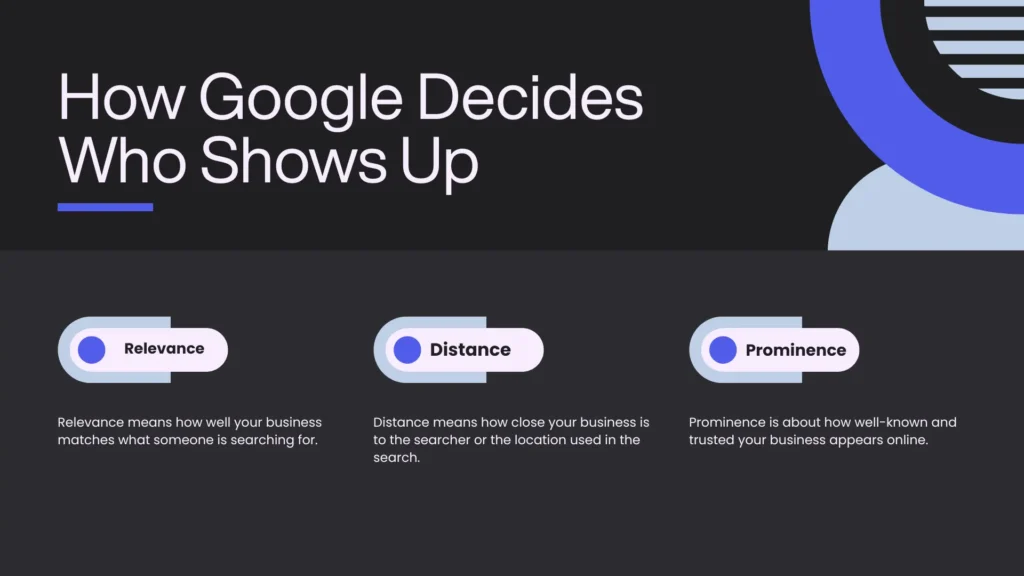
Google says local results are mainly based on three factors: relevance, distance, and prominence. These help Google decide which businesses are the best match for a local search. Google also says there is no way to request or pay for a better organic local ranking. (Google Help)
Relevance
Relevance means how well your business matches what someone is searching for.
For example, if someone searches for “roof repair near me,” Google needs to understand that your business actually offers roof repair, not just general construction work.
If your Google Business Profile, website pages, headings, service descriptions, and content are too generic, Google may not clearly connect your business with the search.
Distance
Distance means how close your business is to the searcher or the location used in the search.
If someone searches for “dentist in Toronto” or “renovation company in Pordenone,” Google looks at location signals. This is why local SEO for businesses needs clear city and service area targeting.
Prominence
Prominence is about how well-known and trusted your business appears online.
Google says prominence can be based on information across the web, including links, articles, directories, review count, and review score. (Google Help)
In simple terms:
Google needs to understand what you do, where you do it, and why it should trust you.
Your Google Business Profile Is Not Properly Optimized
One of the biggest reasons for a business not showing on Google Maps is a weak or incomplete Google Business Profile.
Your Google Business Profile is not just a small listing. For local businesses, it is one of the most important SEO assets you own.
Google explains that a free Business Profile helps businesses appear on Google Search and Maps, and lets them add photos, offers, posts, and business details. (Google Business)
Common problems include:
- Wrong primary business category
- Missing services
- Weak business description
- Poor photos
- No updates or posts
- Missing service areas
- Incomplete opening hours
- No review strategy
For example, if you are a renovation company but your profile category is too broad, Google may not understand your strongest service.
If you are a clinic but your services are missing, you may lose visibility for searches like “dental implants near me,” “physiotherapy near me,” or “aesthetic clinic near me.”
Your profile should clearly explain:
- What you do
- Who you serve
- Where you serve
- What services you offer
- Why people should trust you
Google’s guidelines say your business description should be honest, relevant, and useful, and can include information about services, products, mission, and business history. (Google Help)
This is why Google Business Profile optimization matters. It gives Google stronger information and gives potential customers more reasons to contact you.
Google Does Not Clearly Understand Your Services
One of the most common mistakes I see on local business websites is cramming every service into a single page.
Something like: “We do construction, renovations, painting, roofing, drywall, and maintenance.” All on one page. No detail. No context.
The problem with this is simple. When someone searches for “bathroom renovation company near me,” Google needs a clear, specific page to match that search to. A generic “Services” page that lists 10 different things does not give Google enough to work with.
Take a renovation company, for example. Instead of one page trying to cover everything, it should have separate pages for each core service: bathroom renovation, kitchen renovation, full home renovation, roof repair, drywall installation, interior painting, thermal insulation, and so on.
The same applies to clinics, cleaning companies, landscapers, or any other local business. If people are searching for a specific service in your area, you need a page that clearly matches that search.
Think about how people actually search:
- “dental implants in [city]”
- “laser hair removal clinic near me”
- “commercial cleaning services [city]”
- “landscaping company in [city]”
Each of those searches needs its own landing page to have a real chance at ranking.
Now, this does not mean you should create pages just for the sake of having more pages. Google’s own SEO Starter Guide makes it clear that the point of SEO is to help search engines understand your content and help users actually find what they need. (Google for Developers)
So every service page you create should be genuinely useful. It should explain what the service is, who it is for, what problems it solves, how your process works, which areas you serve, and include things like before/after examples, FAQs, and clear ways to get in touch.
This is exactly where a real SEO strategy makes the difference, not just making a website “look nice,” but building pages that actually match how your customers search.
Your Location Targeting Is Weak
If your business serves local customers, Google needs to know exactly where. And “We serve all areas” is not enough.
This is a mistake I see constantly. A business wants to show up for searches in specific cities or neighborhoods, but their website never actually mentions those places. There is nothing on the site that tells Google, “Yes, we work in this area.”
Compare these two approaches:
“We offer cleaning services.” vs. “We offer residential and commercial cleaning services in Toronto, Mississauga, North York, and the Greater Toronto Area.”
The second version gives Google real location signals to work with. The first one gives nothing.
For businesses that cover multiple cities or regions, it often makes sense to create dedicated service area pages. Something like /areas/toronto/, /areas/mississauga/, or /areas/tirana/. But here is where a lot of businesses get it wrong: they create five or ten city pages that all say the exact same thing, just with the city name swapped out.
Google sees through that. And so do your potential customers.
A service area page only works if it is actually useful. Talk about the services you offer in that specific location. Include real project examples or case studies from that area. Add photos from actual jobs you have done there. If customers in that city tend to have specific needs or challenges, address those directly. Add testimonials from local clients if you have them, and make it easy for someone to get in touch.
If you want to rank higher on Google Maps, your location signals need to be consistent in two places: your Google Business Profile and your website. One without the other leaves gaps that your competitors are probably filling.
This matters especially for contractors, clinics, dentists, landscapers, cleaning companies, renovation businesses, and beauty or aesthetic businesses that serve multiple areas. If you cover more than one city, your website should reflect that clearly.
Your Website Is Not Built for Search
A beautiful website can still perform badly on Google.
Design matters, but search structure matters too.
Many businesses have websites that look decent but are weak for SEO because they have:
- Weak page titles
- Poor headings
- Slow loading speed
- Bad mobile experience
- No internal links
- No schema markup
- Thin service pages
- No clear calls to action
- No local landing pages
Google’s SEO Starter Guide explains that SEO helps search engines understand your content and helps users decide whether they should visit your site from search results. (Google for Developers)
For a local business, your website should not be just an online brochure.
It should be a lead-generation asset.
That means every important page should answer:
- What service do you offer?
- Where do you offer it?
- Why should someone trust you?
- What should the visitor do next?
- How can they contact you quickly?
This is where web development and web design need to work together with SEO.
A site that only looks modern but has no SEO structure will not help much.
A site that ranks but does not convert visitors into calls or form submissions is also incomplete.
The goal is both visibility and conversion.
You Do Not Have Enough Trust Signals
Google is not the only one judging your business.
Customers are judging you too.
If your competitors have many reviews, project photos, testimonials, case studies, and visible proof, while your business has almost none, they will usually look safer.
Trust signals include:
- Google reviews
- Testimonials
- Case studies
- Before/after photos
- Project galleries
- Certifications
- Team photos
- Clear contact information
- Years of experience
- Client logos or partnerships
- Industry-specific proof
Google includes review count and review score as part of its explanation of prominence in local ranking. (Google Help)
But reviews must be real.
Do not buy fake reviews. Do not use fake incentives. Do not ask people who never used your service to leave reviews.
That can damage trust and may violate platform policies.
For local businesses, real project proof is powerful.
A renovation company should show real renovations.
A dentist should show trust, professionalism, and patient experience where allowed.
A landscaper should show before/after work.
A beauty clinic should show the environment, results where appropriate, and customer confidence.
A cleaner should show quality, process, and reliability.
You can also build deeper proof through case studies and project examples.
Your Business Information Is Inconsistent Online
Google needs confidence that your business information is correct.
If your name, address, phone number, website, opening hours, or service areas are inconsistent across the web, that can create confusion.
This is often called NAP consistency:
- Name
- Address
- Phone number
Common problems include:
- Old phone numbers on directories
- Wrong address on older profiles
- Duplicate Google Business Profiles
- Different business names across platforms
- Old websites still indexed
- Social profiles with outdated information
- Directory listings with wrong categories
For example, one directory may say your business is in one city, another says another city, and your website does not mention either clearly.
That weakens trust.
Your business should audit its online presence and update important listings, including:
- Google Business Profile
- Yelp or industry directories
- Local business directories
- Chamber of commerce pages
- Niche platforms relevant to the industry
The point is simple:
Google and customers should see the same business information everywhere.
Your Competitors Have Stronger Local SEO Assets
Sometimes the reason you are not showing up is not that your business is bad.
It is that your competitors have built stronger local SEO assets.
They may have:
- Better service pages
- More Google reviews
- Better photos
- Stronger backlinks
- More local mentions
- More active Google Business Profiles
- More consistent content
- Better website structure
- Stronger internal linking
- More trust signals
This is why asking only “how to get my business to show up on Google” is not enough.
The better question is:
“What does Google see from my competitors that it does not see from me?”
If a competitor has a dedicated page for “bathroom renovation in Toronto,” 70 reviews, before/after photos, local backlinks, and an active Google profile, while you only have a basic homepage and 3 reviews, the gap is clear.
You do not need to copy competitors blindly.
But you do need to understand what assets they have built.
This is where a serious digital marketing consulting process helps. It shows what is missing, what matters, and what should be prioritized first.
You Are Not Tracking What Is Happening
Many business owners do not know what is happening because they are not tracking anything properly.
They do not know:
- Which keywords they appear for
- Which pages get impressions
- Which pages get clicks
- Which forms are submitted
- Which calls come from Google
- Which leads become real customers
- Which marketing activities are working
Google Search Console helps website owners measure search traffic, review performance, fix issues, and see which queries bring users to the site. (Google)
Google’s Performance report also shows important metrics about how a website performs in Google Search results, including queries, traffic changes, clicks, and impressions. (Google Help)
At minimum, a local business should have:
- Google Search Console
- Google Analytics
- Google Business Profile insights
- Form submission tracking
- Call tracking
- Lead source tracking
- CRM or lead management system
Without tracking, you are guessing.
You may think SEO is not working, but maybe your pages are getting impressions and not enough clicks.
Or maybe people visit your site, but the page does not convert.
Or maybe the phone number gets clicks, but nobody answers quickly.
SEO is not just rankings. It is a system that should connect visibility to actual leads.
You Treat Google Visibility as a One-Time Setup
Google visibility is not a one-time setup.
Many business owners create a website, claim their Google Business Profile, add a few photos, and then stop.
That is not enough in competitive local markets.
Your competitors are improving. Google is changing. Customer behavior is changing. New businesses are entering the market.
A strong local SEO system needs ongoing improvement.
That can include:
- Updating Google Business Profile photos
- Adding posts or updates
- Getting new real reviews
- Publishing useful service content
- Improving existing pages
- Adding project examples
- Building internal links
- Monitoring competitors
- Fixing technical SEO issues
- Tracking leads and conversions
- Improving calls to action
Google visibility should be treated like a business asset.
You build it, maintain it, improve it, and measure it.
That is how you turn SEO into a long-term lead-generation channel.
Quick Checklist: Why You Are Not Showing Up
Use this checklist to quickly diagnose why your business is not showing up on Google or Google Maps.
Google Business Profile
- Is your profile verified?
- Is your primary category correct?
- Are your services added?
- Is your description clear?
- Are your photos updated?
- Are your service areas listed?
- Are your opening hours correct?
- Are you getting real reviews consistently?
Website SEO
- Do you have dedicated service pages?
- Are your titles and headings clear?
- Does each page target a specific service?
- Is your website fast?
- Does it work well on mobile?
- Do you use internal links?
- Do you have schema markup?
- Do you have clear CTAs?
Local SEO
- Do you mention your target cities?
- Do you have location or service area pages?
- Do you show local project examples?
- Is your business information consistent online?
- Do local directories show the correct details?
Trust
- Do you have testimonials?
- Do you show real project photos?
- Do you have case studies?
- Do you display reviews?
- Do you show proof of experience?
Tracking
- Do you have Search Console installed?
- Do you have Analytics installed?
- Do you track calls?
- Do you track forms?
- Do you know which leads come from Google?
If you answer “no” to many of these, the problem is not just your website.
The problem is your local growth system.
How to Fix It: Build a Local Growth System
To fix your Google visibility, you need more than a basic website.
You need a local growth system.
That system should connect:
- Google Business Profile optimization
- Dedicated service pages
- Location targeting
- Reviews
- Trust signals
- Technical SEO
- Content
- Internal linking
- Tracking
- Monthly improvements
Here is how the system works.
Your Google Business Profile helps you appear on Google Search and Maps.
Your service pages help Google understand exactly what you offer.
Your location targeting helps Google connect your business with local searches.
Your reviews and testimonials build trust.
Your project photos and case studies prove your work.
Your tracking shows what is working and what needs improvement.
Your monthly SEO improvements keep the system moving forward.
This is the difference between “having a website” and having a digital system that helps generate leads.
A proper system answers the customer’s search, builds trust, and gives them a clear reason to contact you.
That is how you move from invisible to visible.
And from visible to contacted.
To see how this connects with a complete service strategy, you can explore the services page or learn more about my approach on the about page.
Final Thoughts
If your business is not showing up on Google, do not assume the only problem is your website.
Your website may be part of the problem, but local visibility depends on the full system around it.
Google needs to understand:
- What you do
- Where you do it
- Why customers trust you
- How active and reliable your business is
- Whether your online presence supports your claims
If you want to rank higher on Google Maps and generate more leads, you need to build the right assets.
Not random SEO tricks.
Not fake promises.
Not keyword stuffing.
A real local SEO system.
One that brings together your Google Business Profile, website, service pages, location targeting, reviews, trust signals, and tracking.
Book a Free Google Visibility Audit.
Start here: Contact Sabian Zhupa
FAQs
Why is my business not showing up on Google?
Your business may not be showing up on Google because your Google Business Profile is incomplete, your website does not clearly explain your services, your location targeting is weak, your reviews are limited, or Google does not have enough trust signals about your business.
Why is my business not showing on Google Maps?
Your business may not show on Google Maps if your Google Business Profile is not verified, your category is wrong, your service areas are missing, your business information is inconsistent, or competitors have stronger local SEO signals.
How do I get my business to show up on Google?
Start by verifying and optimizing your Google Business Profile, creating clear service pages, adding location targeting, collecting real customer reviews, improving your website SEO, and tracking your search performance with tools like Google Search Console.
How can I rank higher on Google Maps?
To rank higher on Google Maps, improve your relevance, distance signals, and prominence. That means choosing the right category, adding services, improving reviews, keeping information accurate, adding photos, and building a stronger local SEO presence over time.
Do I need SEO if I already have a website?
Yes. Having a website does not automatically mean people will find you. SEO helps Google understand your services, locations, trust signals, and content so your business has a better chance of appearing for relevant searches.